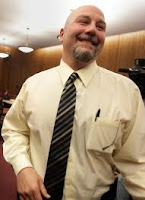
Former Ohio death row inmate Joe D'Ambrosio, finally free, speaks out

Joe D'Ambrosio
Source: Gamso - For the Defense
Attempted murder. That's what Joe D'Ambrosio wants the prosecutors to be charged with. He says the Cuyahoga County Prosecutor's Office tried to kill him by withholding 10 pieces of evidence at his trial, evidence that could have led to a not-guilty verdict.

Instead, D'Ambrosio sat on Ohio's death row for more than 20 years.

He is finally free.

On Monday, the U.S. Supreme Court refused to consider the state's appeal against him. The ruling wipes D'Ambrosio's legal slate clean.

They can erase the charges but they can't give him back his life.

D'Ambrosio was 26 when the police arrested him on Sept. 26, 1988 for the murder of Tony Klann. He's now 50 with nothing to show for his life except a '97 Ford Ranger with no radio, no air-conditioning and crank windows.

D'Ambrosio is angry at the prosecutors who withheld information, who called him a liar on the stand.

"They had the truth in their files," he said. "They're all guilty of attempted murder . . . . They tried to do to me what they said I did."

Take a life.

What would he like to tell the prosecutors who withheld the evidence?

"I'll see you in court," D'Ambrosio said. "I'm going to use their law to get justice for me."

D'Ambrosio plans on filing a civil lawsuit.

He has always proclaimed his innocence. He maintains that he was in his apartment the night Klann was killed. At the time, Sgt. Joseph D'Ambrosio had been honorably discharged from the Army after four years. He had no criminal record.

D'Ambrosio took the stand at his trial in front of a 3-panel judge. He'd grown up watching Perry Mason. He expected his attorney to prove his case. He expected to walk out free.

One word changed his life forever:

Guilty.

"I was floating over my body looking down over the defense table and judge," D'Ambrosio said. "It was like a dream – no, a nightmare."

In prison, he clung to his faith. God sent him a Catholic priest, who happened to be a registered nurse and an attorney.

Father Neil Kookoothe, pastor at St. Clarence Catholic Church in North Olmsted, was visiting an inmate on death row at the Mansfield Correctional Institution. The inmate told him to see the guy in the next cell who was probably innocent.

D'Ambrosio asked Father Neil to read his court transcript. The priest read it in one night.

Father Neil looked D'Ambrosio straight in the eye and said, "Tell me you didn't do this. If you ever, ever lie to me, I will drop you like a hot potato."

Joe looked him dead in the eye and said, "I did not kill Tony Klann and had nothing to do with it."

With the help of the priest and endless attorneys, the guilty verdict unraveled. It took over 20 years.

What was D'Ambrosio's worst day on death row?

Pick a day, any day. The day they came to tell him his mom had died. The day he found out the Ohio Supreme Court denied his retrial. Every day locked in a cell with one tiny window and solid wall with a slot big enough for the food tray to pass through. Every day he wasn't allowed to touch another human without a glass wall or fence or phone between them.

What kept him sane?

"My belief in God and my innocence," he said.

When Joe was released from prison 2 years ago, every time he came to a door he waited. That's how it worked in prison. The guards opened the doors, not the inmates.

Freedom still amazes him. To be able to vote, to see the sky. He hadn't seen stars in 20 years.

He got his best night sleep on Monday, after the U.S. Supreme Court decision. He watched it on a computer with Father Neil, then he went home and slept for 12 hours.

Joe D'Ambrosio will never get the apology he deserves from the Cuyahoga County Prosecutor's Office. They still insist he is guilty and believe they could have proved it at another trial.

Rick Bell, criminal investigations chief for the prosecutor's office, insists that D'Ambrosio was not exonerated.

"To use the word exonerated is a misrepresentation," he said Tuesday. "He has not been found innocent."

But in this country's legal system, we are each presumed innocent until proven guilty by a court of law. That court tossed out the guilty verdict, so D'Ambrosio is innocent.

Bell couldn't tell me why prosecutors withheld those 10 pieces of evidence.

He did share changes that have been made in the prosecutor's office but insisted that those changes were made since Joe's case, but not because of it.

The office created a case management system where each prosecutor is ethically responsible for his or her own case files from beginning to end instead of having many prosecutors touch each case file.

The office switched to an electronic case management system so every scrap of paper is date-stamped and placed electronically in the file and retained forever. This allows the prosecutors to see what was provided to defense attorneys.

Joe D'Ambrosio is the 6th person on Ohio's death row to be set free and the 140th inmate on death rows across America to be exonerated.

His future is a mystery. He moved back to North Royalton where he grew up.

He's got no pension, no retirement. He'll get $35 a month in Social Security.

"I didn't pay into it. I have zero," he said. "I have my truck and my apartment. They took everything from me."

He works as a subcontractor doing odd jobs. He hopes a civil lawsuit will compensate him for the missed years of work.

If he could peer into the future, what would he like to be?

He paused for a long moment before answering:

"Happy, I hope."

Source: The Plain Dealer, January 26, 2012

Related articles:
Jan 23, 2012
The state had wanted the court to review a ruling last August by the U.S. Circuit Court of Appeals in favor of former inmate Joe D'Ambrosio, according to The Associated Press. D'Ambrosio was convicted of murder in the death ...
Mar 16, 2010
Cuyahoga County Common Pleas Judge Joan Synenberg ordered Joe D'Ambrosio released without conditions Friday, two days after a federal judge ruled he cannot be retried because a key witness has died. The state is ...

Comments

Most viewed (Last 7 days)

South Korea ferry disaster: Surviving passengers of Sewol tragedy give evidence in court

Surviving passengers of a South Korean ferry which sunk in April, killing 304 people, are due to give evidence in the trial of its captain and 14 crew members. Students from the Danwon High School in Ansan, 18 miles south of Seoul, will testify with other passengers in a smaller court nearer to their home, rather than the one where the defendants are being seen in Gwangju, in the south of the country. The Sewol ferry set sail on 16 April with 476 passengers and crew on board - more than 300 of which were schoolchildren. They were enroute from the mainland to the island resort of Jeju as part of a school trip, when nearing the end of the journey, the vessel, which was overloaded, also made a sharp turn to the right causing it to capsize. Captain Lee Joon-seok, 68, was caught on rescue footage being one of the first to leave the ship, while many passengers, obeying orders, remained in the cabins. It is thought a delayed evacuation order from the captain did n...

Tennessee | Questions Raised About the Doctor Who Was Overseeing Tony Caruthers’ Execution

Mark Fowler, according to a deposition, had not placed a central line in a patient for more than a decade when he attempted to put one in Carruthers Around 11 a.m. Thursday morning in the execution chamber at Riverbend Maximum Security Institution in Nashville, a medical doctor stepped in and attempted to place a central IV line in Tony Carruthers’ chest. By that point, the prison staff had spent some 30 minutes trying unsuccessfully to insert a backup IV line that would allow them to proceed with the lethal injection. According to Carruthers’ attorney Maria DeLiberato, who was in the room, after asking a staff member to attempt inserting a line through Carruthers’ jugular vein, the doctor moved on to the central line, which is identified as the last resort in Tennessee’s lethal injection protocol .

Florida: The Daily Routine of Death Row Inmates

The breakfast carts rattle through the concrete prison at about 5:30 am and as they approach Death Row the first sounds of morning repeat the last sounds of night - remote controlled locks clanging open and clunking closed, electric gates whirring, heavy metal doors crashing shut, voices wailing, klaxons blaring. A maximum security prison has no soft or delicate sounds. At the end of each corridor of death row cells a guard opens a heavy door of steel bars and a prison trusty pushes a breakfast cart inside. The door closes behind him and when it locks a second door opens and admits the trusty to the wing. He steers his cart along the wing stopping at each cell to pass a tray of powdered eggs and lukewarm grits through a small slot on the bars. Food is prepared by prison staff and transported in insulated carts to the cells. The food carts are full of cockroaches, the food is often undercooked or just rotten and is served on Styrofoam plates with a plastic "spork" - fork/spoon...

Arizona executes Leroy McGill

Arizona executes inmate who set couple on fire in 'horrific attack' Arizona has executed Leroy McGill for setting 21-year-old Charles Perez and his 24-year-old girlfriend on fire. Perez died the next day and Perez survived with severe burn injuries.  Arizona has executed a death row inmate for setting 2 people on fire more than 20 years ago, killing 1 of them and changing the other's life forever.  The state executed Leroy McGill, 63, by lethal injection on Wednesday, May 20, for the 2002 murder of 21-year-old Charles Perez. McGill set Perez and his girlfriend on fire after they accused him of theft, court records say. Perez died of his injuries the next day while his girlfriend survived with severe burns. 

20 Minutes to Death: Witness to the Last Execution in France

The following document is a firsthand account of the final moments of Hamida Djandoubi, a convicted murderer executed by guillotine at Marseille’s Baumettes Prison on September 10, 1977. The record—dated September 9—was written by Monique Mabelly, a judge appointed by the state to witness the proceedings. Djandoubi’s execution would ultimately be the last carried out in France before capital punishment was abolished in 1981. At the time, President Valéry Giscard d'Estaing—who had publicly voiced his "deep aversion to the death penalty" prior to his election—rejected Djandoubi’s appeal for clemency. Choosing to let "justice take its course," the President allowed the execution to proceed, just as he had in two previous cases during his term:   Christian Ranucci , executed on July 28, 1976 and Jérôme Carrein , executed on June 23, 1977. Hamida Djandoubi , a Tunisian national, was sentenced to death for killing his former lover, Elisabeth Bousquet. He was execu...

Tennessee fails to execute Tony Carruthers after IV difficulties. State won't try again for a year

NASHVILLE, Tenn. (AP) — Tennessee officials on Thursday called off the lethal injection of Tony Carruthers, who was convicted of kidnapping and murdering three people in 1994, after his executioners tried and failed for over an hour to establish an intravenous line. Gov. Bill Lee announced soon afterward that the state would not try again for at least a year. In a written statement, the Tennessee Department of Corrections said medical personnel had quickly established a primary IV line but were unable to find a suitable vein for a backup line as required by the state’s execution protocol. Efforts to insert a central line also failed, and officials called off the execution.

EU GSP+ Reform: Will Brussels Finally Enforce Its Own Conditions on Pakistan?

The EU has tightened the rules governing GSP+ trade preferences, but Pakistan’s record raises a harder question: whether Brussels is prepared to suspend market access when a major beneficiary fails to demonstrate sustained compliance with human rights, labour and governance obligations. The European Union has formally adopted revised rules for its Generalised Scheme of Preferences, strengthening the conditions attached to preferential market access for developing countries. The new framework will apply from 1 January 2027 and is intended to tighten monitoring, widen the list of international conventions, and make suspension of benefits easier in cases of serious violations.

Former Oklahoma death row inmate Richard Glossip goes free on $500k bond

Richard Glossip was released from jail Thursday, May 14, on a $500,000 bond, a major victory for the former death row inmate who has come so close to execution that he has had three last meals. Glossip, 63, is awaiting his third trial in his 1997 murder-for-hire case. He walked out the front door of the Oklahoma County jail, holding hands with his wife, Lea Glossip, as a stiff Oklahoma breeze whipped his hair. "I'm just thankful for my wife and my attorneys," he told reporters. "I'm just happy." His release came hours after Oklahoma County District Judge Natalie Mai set bail in a 13-page order that pointed to issues with the key witness against him.

New Mississippi billboard warns criminals: ‘Firing squad is legal’

DESOTO COUNTY, Miss. (WREG) — A billboard standing on Interstate 55 southbound as you cross the Tennessee state line and enter Mississippi from Memphis is sending a grim message to those coming into the state. DeSoto County District Attorney Matthew Barton recently announced the new billboard campaign, which features the sign reading, “WELCOME TO MISSISSIPPI. WHERE THE FIRING SQUAD IS LEGAL. THINK TWICE.” It references Mississippi’s law permitting execution by firing squad under certain circumstances for inmates sentenced to death. Barton says this campaign is aimed at deterring violent crime and sends a direct message to criminals entering Mississippi.

Florida executes Richard Knight

Man convicted of killing a woman and her 4-year-old daughter is executed in Florida  A Florida man convicted of fatally stabbing his cousin’s girlfriend and the couple’s 4-year-old daughter was put to death Thursday evening, becoming the 7th person executed by the state this year.  Richard Knight, 47, was pronounced dead at 6:13 p.m. following a 3-drug injection at Florida State Prison near Starke. Knight was convicted of 2 counts of 1st-degree murder in the June 2002 killings of Odessia Stephens and her daughter, Hanessia Mullings.  The curtain of the death chamber went up promptly at the scheduled 6:00 p.m. execution time. Knight was already strapped down with his arms extended and an IV line in place.