 |
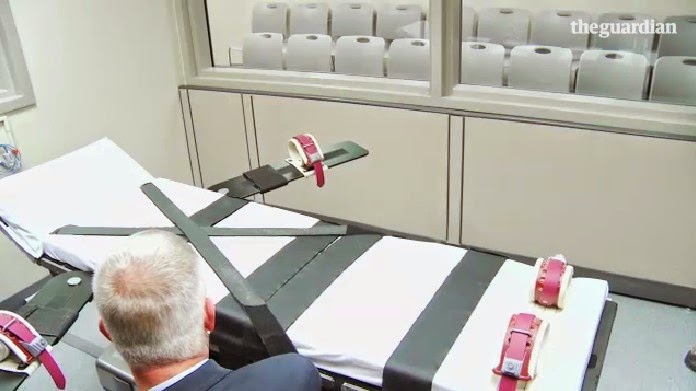
| Oklahoma death chamber |
A little after 1:30 p.m. Wednesday, Oklahoma Department of Corrections staff told Richard Glossip he was about to enter the Oklahoma State Penitentiary's death chamber area to await his death by lethal injection.
Glossip, who had already given the state his possessions and the evening before had eaten what he thought would be his final meal, was in an adjacent cell. A few minutes later, prison workers learned that there was no word from the U.S. Supreme Court about Glossip's appeals, so they told him the process was on hold.
He said he eventually covered himself with a sheet and got on the floor to wait for the Supreme Court's decision. The ruling denying his stay requests came down at 2:56 p.m., but he was never notified of it.
No one inside the facility talked to Glossip until just before 4 p.m. He was supposed to have been dead at that point by a combination of midazolam, a sedative; rocuronium bromide, a paralytic; and potassium chloride, which stops the heart.
The shock came when Gov. Mary Fallin issued an executive order granting him a 37-day stay. However, it had nothing to do with Glossip's claims of innocence. Fallin's order stated the Department of Corrections had obtained potassium acetate rather than potassium chloride for the lethal injection.
Although potassium acetate is, according to medical professionals questioned by the state, medically interchangeable with potassium chloride, the fact that it is not listed in the Department of Corrections' 3-drug protocol created a "legal ambiguity," Fallin said.
Attorney General Scott Pruitt asked the Oklahoma Court of Criminal Appeals on Thursday to issue an indefinite stay of execution for Glossip, as well as for Benjamin Cole and John Grant, who were scheduled to die this month. The court unanimously decided to grant that request Friday and ordered the state to file a status report every 30 days about the case until the stay is dissolved.
Pruitt's office has opened an inquiry into the handling of Wednesday's scheduled execution. But the answers are limited as to how the Department of Corrections landed in a situation where it must again defend its execution policies.
State 'briefly considered' moving forward with execution
Fallin said Thursday that her office first received word of a possible issue with the lethal-injection drugs early Wednesday afternoon and that officials there discussed whether the DOC would be able to obtain the drug described in the protocol. Because the DOC reported that it was unable to do so in time, the governor eventually announced a stay "out of an abundance of caution."
But Alex Weintz, Fallin's spokesman, said a medical professional told DOC personnel that the drugs were identical in function and that the agency could therefore proceed with the execution.
"Given that advice, the state did briefly consider moving forward," Weintz said Friday. "The distinction between potassium chloride and potassium acetate is not important for any medical or scientific reason."
Its relevance, he said, is because of the "litigious nature" of the death penalty and the fact that DOC protocol specifically calls for potassium chloride. Weintz maintained the DOC followed protocol and notified other officials as soon as personnel realized there was an issue.
DOC Director Robert Patton told reporters Thursday that an execution team member discovered that the supplier had provided potassium acetate instead of potassium chloride when the sealed box containing drugs for Glossip's execution was opened about 1 p.m. Wednesday.
He said lethal-injection drugs must be delivered to the prison on the day of an execution because the DOC does not have a DEA license to store drugs. However, the DEA has only 1 of the 3 drugs - midazolam - classified as a controlled substance.
Mark Woodward, spokesman for the Oklahoma Bureau of Narcotics and Dangerous Drugs Control, told the Tulsa World that if the DOC wants to keep a controlled substance on site outside of a prescription for an inmate, state and federal law would require that the agency obtain a license from his department as well as from the DEA. No DOC facility at this time has a license from his bureau for storing such a substance, he said.
"They do not need a license from OBN or DEA for (storing) the other 2 non-CDS drugs," Woodward said via email.
When asked about that issue Friday, DOC spokesman Alex Gerszewski said that "all of the drugs are brought to the facility at the same time for security purposes" and that the DOC does not obtain parts of the drug protocol separately.
An Aug. 11 letter from the Attorney General's office to Glossip's federal public defenders states that the office had confirmed with the DOC that it had obtained the necessary drugs for Glossip's, Cole's and Grant's executions. Gerszewski said that letter meant the supplier confirmed that it had the drugs, not that the DOC actually had them in its possession.
However, Dale Baich, one of Glossip's federal attorneys, disputed that claim and called it "an attempt to rewrite history." Baich is representing Glossip in the Glossip v. Gross case, which challenges the use of midazolam in executions.
"The attorney general wrote that the drugs 'have been obtained,'" Baich said of the letter. "He went on to write that the drugs were 'manufactured' and that 'none of the drugs will expire prior to the current execution dates.' How could those representations be made if the DOC did not have the drugs?"
As for Weintz's statement indicating the state considered allowing Glossip's execution to proceed, Baich said it was "shocking" to learn that there was discussion about violating the protocol.
"The public is asked to take DOC at its word that it will follow the protocol when carrying out the ultimate punishment by the state," he said. "In light of previous statements by the state, how can the DOC be trusted?"
As of last week, potassium chloride is listed by the FDA as being in short supply in the United States. Patton said Thursday that the supplier had not notified the DOC beforehand that it was sending potassium acetate instead of potassium chloride, a practice he said is acceptable in the medicine industry.
As of Sunday, the DOC could not confirm whether the supplier's decision to provide an alternative drug is a result of the potassium chloride shortage.
The drugs intended for Wednesday's execution were turned over to the state Medical Examiner's Office, which will provide them to the Oklahoma State Bureau of Investigation for destruction, Gerszewski said.
Secrecy leads to mistakes, attorney and expert say
In 2011, Oklahoma lawmakers approved a law banning the release of information about participants in executions, including executioners and drug suppliers. Evidence of purchasing drugs and other equipment needed to carry out executions is also secret under the law, and petty cash is used to pay medical workers to further protect their identities.
But Baich and a death-penalty researcher told the Tulsa World such statutes take away the public's ability to prevent mistakes.
"It wasn't just Glossip and his lawyers and the public who were kept in the dark," said Robert Dunham, executive director of the Death Penalty Information Center. "The Attorney General's Office was blindsided by the DOC's failures. And the AG's Office in fact had made representations to the federal court on at least 2 occasions that potassium chloride was going to be used and there was going to be no deviation from the protocol."
The DOC's execution policy states that Oklahoma State Penitentiary Warden Anita Trammell will ensure that "execution inventory and equipment checks" are completed 2 days ahead of an execution. The policy also requires the department to notify inmates 10 days in advance about which protocol will be used for their executions, though the policy also indicates that Patton has the discretion to modify the protocol.
When asked what the execution inventory entails, Gerszewski said Trammell makes sure items such as syringes are at the facility and that all other items required to carry out the execution are on hand.
Fallin's office issued a question-and-answer handout to media Thursday stating that same-day delivery of execution drugs does not violate protocol, because no timeline for obtaining chemicals and equipment is listed in the policy.
Dunham said potassium acetate has never been used in a U.S. execution and that the DOC's inability to store the drugs and test their quality beforehand is an "administrative failure."
"If you are going to be carrying out an execution, you have to have administrative procedures and protocols in place that will assure that you can examine what drugs you have, determine the right drugs and, if they are the right drugs, determine they are of sufficient purity and quality and efficacy that they won't produce a torturous execution," Dunham said.
Patton said during Thursday's news conference that he, not Trammell, is responsible for upholding the execution drug protocol and policy. Gerszewski said the H Unit section chief, who is tasked with applying approved procedures for death-row inmates on execution day, did his or her job as outlined.
When asked Thursday about efforts to obtain potassium chloride, Patton said the DOC will continue to search for a supply, but he added, "As of right now, I don't believe we have it."
Dunham said Wednesday's events provide "additional ammunition" to critics of the death penalty who allege states are incapable of carrying it out properly.
"There's no instance that I am aware of in which a state has waited so long and been so unprepared that it did not notice it had the wrong drugs until it was time to administer them," he said. "There's no clearer example I can think of of a state getting it wrong than Oklahoma not knowing until the execution is about to occur that it doesn't even have the right drugs."
Pruitt's office declined to comment further on the matter Friday but emphasized that his office will continue to look into the events leading up to Glossip's stay.
"The state owes it to the people of Oklahoma to ensure that, on their behalf, it can properly and lawfully administer the sentence of death imposed by juries for the most heinous crimes," he has said.
Source: Tulsa World, October 4, 2015
Report an error, an omission: deathpenaltynews@gmail.com