 |
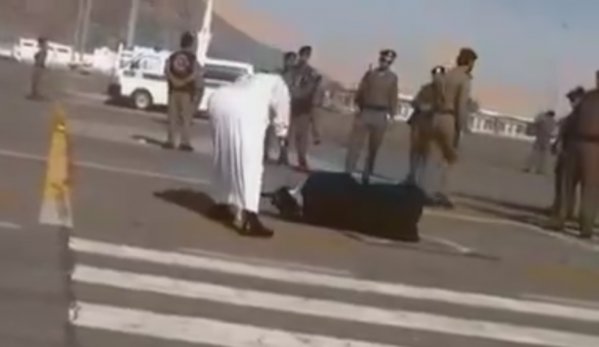
| Public execution in Saudi Arabia (file photo) |
Saudi Arabia has carried out its 90th execution of this year, equaling the total number executed in the country in 2014.
Amnesty International report that the toll is “one of the highest recorded by the organization during the same period for more than three decades”. The toll so far this year “marks an unprecedented spike in executions for a country already ranked among the most prolific executioners in the world,” a statement from the group said today.
Saudia Arabia is one of the world’s top three executioner nations, behind only Iran and China. The most common method of execution is beheading, often conducted in public squares and occasionally by firing squad.
“With the year yet to pass its midpoint … this alarming surge in executions surpasses even the country’s own previous dreadful records,” said Said Boumedouha, Deputy Middle East and North Africa Programme Director at Amnesty International.
Today’s execution took place in Riyadh, and was of a Pakistani man convicted on drug-related charges. Drug-related offences are one of the most common reasons for execution, with almost half of all killings this year in some way drug-related. Amnesty International warn that the use of the death penalty for drug-related offences international law.
Many of those sentenced to death in Saudi Arabia are convicted based solely on “confessions”, which are obtained under duress. Many trials are also held in secret, with the accused parties not made aware of the progress of their case.
The Supreme Court has recently decreed that in cases of crimes punishable by death the judge in the trial is free to sentence someone to death without a guilty conviction, but merely with suspicion.
“The Saudi Arabian authorities’ unwavering commitment to this brutal form of punishment is utterly gruesome considering the deep flaws in its justice system,” said Said Boumedouha.
“The use of the death penalty is cruel and inhumane in any circumstance, but it is even more outrageous when meted out as a punishment against someone convicted in a trial that itself makes a mockery of justice.”
Colm O’Gorman, Executive Director of Amnesty International Ireland said, “The death penalty is never a just response to any crime. It is no particular deterrent. Instead of expediting executions and advertising recently for more executioners as Saudi Arabia did recently, the Saudi authorities should be reversing this very worrying trend.
“Saudi Arabia should establish a moratorium on executions immediately with a view to abolishing the death penalty”.
Source: NewsTalk, May 28, 2015
90 executions this year beat 2014's disgraceful record
Saudi Arabia today has carried out its 90th execution so far this year, equalling the number of people executed in the Kingdom during the whole of 2014, said Amnesty International.
The death toll is one of the highest recorded by the organization during the same period for more than three decades and marks an unprecedented spike in executions for a country already ranked among the most prolific executioners in the world.
"With the year yet to pass its midpoint, the Gulf Kingdom has raced towards this shocking toll at an unprecedented rate. This alarming surge in executions surpasses even the country's own previous dreadful records," said Said Boumedouha, Deputy Middle East and North Africa Programme Director at Amnesty International.
Today's execution carried out in Riyadh was of a Pakistani man convicted on drug-related charges. Almost half of the executions carried out so far this year were for drug-related offences. These do not fall into the category of "most serious crimes", and the use of the death penalty for such offences violates international law. The authorities themselves do not categorize drug-related offences as crimes subject to divinely ordained punishment under Shari'a law, instead they consider the use of the death penalty for such offences a discretionary punishment.
Saudi Arabia's most common method of execution is beheading, often conducted in public squares. Occasionally prisoners in some southern provinces are executed by firing squad.
Many defendants in Saudi Arabia, including those sentenced to death, are convicted after flawed court proceedings that routinely fall far short of international standards for a fair trial. They are often convicted solely on the basis of "confessions" obtained under duress, denied legal representation in trials which are sometimes held in secret and are not kept informed of the progress of the legal proceedings in their case.
For some crimes punishable by death, the Supreme Court has recently confirmed that judges do not need to prove guilt but can sentence someone to death at their own discretion based on suspicion alone.
"The Saudi Arabian authorities' unwavering commitment to this brutal form of punishment is utterly gruesome considering the deep flaws in its justice system," said Said Boumedouha.
"The use of the death penalty is cruel and inhumane in any circumstance, but it is even more outrageous when meted out as a punishment against someone convicted in a trial that itself makes a mockery of justice."
"The Saudi Arabian authorities' unwavering commitment to this brutal form of punishment is utterly gruesome considering the deep flaws in its justice system"----Said Boumedouha
Worryingly, a significant number of Shi'a protesters have been sentenced to death in the past 2 years. These are often in relation to protests in the Kingdom's Eastern Province in the aftermath of the 2011 mass popular uprisings which toppled a number of long-standing authoritarian rulers in the region. Among those sentenced to death is Saudi Arabia's most prominent Shi'a cleric Sheikh Nimr al-Nimr, who was sentenced to death in October 2014 after a deeply flawed trial. His nephew, Ali-al-Nimr, a juvenile offender, was sentenced to death in May 2014 solely based on "confessions" that he claimed were extracted under torture. The imposition of death sentences against individuals who were below 18 years of age when the crime was committed is prohibited under international law.
6 other Shi'a protesters were sentenced to death in the past year and scores of others await trial on charges for which the prosecution has called for the death penalty. Many of them have complained of ill-treatment in detention and of unfair trials.
The claim by the Saudi Arabian authorities that the death penalty is a deterrent to crime is unfounded.
"There is no convincing evidence that the death penalty is a particular deterrent to crime, or that it is more effective than other forms of punishment. Instead of expediting executions the Saudi Arabian authorities should immediately establish a moratorium on executions with a view to abolishing the death penalty," said Said Boumedhoua.
Background
In Amnesty International's latest global report on the death penalty, published in April 2015, Saudi Arabia ranks among the top 3 executioners in the world, surpassed only by China and Iran.
As of 31 December 2014, 140 countries have abolished the death penalty in law or practice. Amnesty International opposes the death penalty in all cases without exception, regardless of the nature or circumstances of the crime; the guilt or innocence of the individual; or the method of execution.
Source: Amnesty International, May 28, 2015
Report an error, an omission: deathpenaltynews@gmail.com