America’s Place in the Executioners’ Club

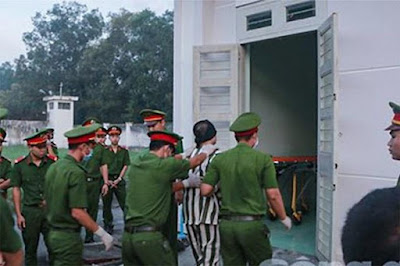
'The Walls' Unit, Huntsville, Texas
What do Texas, Missouri, Georgia and Florida have in common with China, Iran, Pakistan and Saudi Arabia? All are outliers in their continued use of the death penalty, which is being abandoned in most of the rest of the United States and the world.

Those four states were responsible for all but two of America’s 28 executions last year. Likewise, those four countries account for the overwhelming majority of global executions, according to a new report by Amnesty International. The report documented 1,634 executions globally in 2015, not counting China, which executes more people than all other countries combined, but provides little reliable information.

There are many more executions that are not included in Amnesty’s global count, which is restricted to “judicial” executions — those that result from a formal trial process, whether or not that process meets international standards of fairness — and excludes some secret executions and those where no trial took place.

The 1,634 state killings — almost nine in 10 occurred in Iran, Pakistan and Saudi Arabia — represent a 50 percent increase over 2014. Explanations for the spike differ: Pakistan had not executed anyone since 2008, but reinstated the death penalty after the December 2014 terror attack on a military school in Peshawar that killed 132 children. Many of Pakistan’s 326 executions were for crimes other than terrorism.

Most of Iran’s 977 executions were for drug-related offenses, including trafficking more than 30 grams of heroin or cocaine. In Saudi Arabia, foreigners, including migrant workers, accounted for about half of the country’s documented executions, often for minor offenses like drug dealing. As in the United States, there is no evidence that the death penalty has reduced the incidence of capital crimes in these countries.

The good news is that outside of these few places, the death penalty is on the decline. In the United States, 18 states and the District of Columbia have abolished the death penalty, and 12 more have not executed anyone in nine years or longer. Last year the numbers of executions and death sentences nationwide were their lowest in decades.

Globally, four more countries abolished the death penalty in 2015, for a total of 102 countries — up from just 16 in 1977, when record-keeping began — while 38 more countries have not used the death penalty in at least 10 years. Amnesty considers these countries to have effectively abandoned the practice.

The consensus that the death penalty is both ineffective and barbaric is growing, but that consensus is fragile. In Hungary, which abolished the death penalty in 1990, Prime Minister Viktor Orbán responded last April to his country’s immigration crisis by saying that capital punishment “should be put on the agenda.”

Even though Mr. Orbán was swiftly rebuked across Europe, his comments are a reminder that the temptation among opportunistic politicians to bring back the death penalty is always there.
Source: The New York Times, The Editorial Board, April 11, 2016

- Report an error, an omission: deathpenaltynews@gmail.com - Follow us on Facebook and Twitter

Most viewed (Last 7 days)

California | Becerra vows to extend moratorium despite past support for capital punishment

SACRAMENTO—Democrat Xavier Becerra defended the death penalty while serving as California’s attorney general, a punishment his office actively sought in the case of a gunman convicted of an Orange County mass shooting, but as the front-running candidate for governor, he has vowed to block executions if elected in November. Becerra said he will extend the blanket reprieve for all death row inmates that Gov. Gavin Newsom enacted by executive order in 2019, saying he supported “moving our state away from a costly, flawed system that disproportionately impacts Black and brown communities and too often gets it wrong.”

Iran | Afghan Citizen Executed in Wheelchair Due to Severe Mobility Disability

KABUL, AFGHANISTAN – Iranian authorities have reportedly executed an Afghan citizen, identified as Valijan Nourzay, at the central prison in Rafsanjan, according to the human rights organization Hengaw. Hengaw said in a statement on Sunday, September 6, that Nourzay was executed early Wednesday last week at Rafsanjan Central Prison. According to the organization, Nourzay had a severe mobility disability and was executed while in a wheelchair. Hengaw, citing informed sources, reported that Nourzay had been pursued by Iranian authorities three years ago over an alleged murder. He was reportedly seriously wounded after Iranian security forces opened fire on him in Rafsanjan before being arrested and later sentenced to death.

Egypt TV presenter and 11 others sentenced to death in major drugs case

Egyptian television presenter Sarah Khalifa and 11 others have been sentenced to death by hanging after being convicted of drug trafficking and rape, while nine defendants received life sentences and seven were acquitted. Egyptian television presenter Sarah Khalifa, 39, has been sentenced to death by hanging along with 11 other defendants after being found guilty in a drugs case involving a criminal gang accused of importing ingredients used to manufacture narcotics for sale.

He Spent 27 Years on Death Row as a Wrongfully Convicted Man. What Comes Next?

23-hour solitary confinement. 115-degree heat. Jimmie Duncan is haunted by the decades he spent in Louisiana’s Angola Prison—and how, even after being released, he still isn’t truly free. Jimmie “Chris” Duncan wiped the sweat off his forehead as he assessed his temporary home from the parking lot of a rundown motel in central Louisiana. Sure, there’s drug dealing and prostitution, he said on a recent summer afternoon. And he suspected his neighbors were cooking meth on a floor below the room he paid $350 a week to rent.

Hanging, confinement and the sentencing debate India won’t have

Ask anybody what a “death sentence” in India actually means, and the honest answer is that it can mean three quite different things. It can mean the noose—hanging by the neck until death; it can mean permanent confinement in jail—a term the courts now call imprisonment for the remainder of one’s natural life, and, far more often than either of the first two, it can simply mean delay in delivery of justice—a death sentence that is neither carried out nor commuted, waiting for completion of investigation, trial before the sessions court, hearing of a confirmation proceeding in a high court, appeal against conviction in the Supreme Court, or hearing of a mercy petition nobody has decided for years, sometimes for decades, until age or illness does what the state never got around to doing itself.

California | He spent 19 years on death row. His conversion to Judaism helped him endure

Johnny Morales struggled to find sleep. He dozed off for a few moments, but officers came to his death row cell and woke him a little after midnight. They needed to inventory and box up his belongings. He was leaving San Quentin.  Hands cuffed behind his back, he walked across the empty upper yard in the dim gray hours before daylight. An officer walked alongside him step for step, black latex-gloved fingers holding onto Morales’s arm. For almost 20 years, Morales could only experience the world outside his 4-by-11 foot cell in the condemned housing unit like this—chained and escorted by officers. Security protocols required all death row residents be handcuffed or shackled any time they were out in open space with staff.

Arizona AG seeks execution date for man convicted in 1995 trooper killing

Trooper Bob Martin was killed during a traffic stop on the Beeline highway; execution for his killer could be as soon as January PHOENIX (AZFamily)—The Arizona Attorney General is asking for an execution date to be set for a man convicted in the killing of an Arizona State Trooper over 30 years ago. On Aug. 15, 1995, Trooper Bob Martin was shot and killed while performing a traffic stop along the Beeline Highway.

Ex-corrections officials urge governor to commute Kansas death sentences

Former Kansas corrections officials are urging Governor Laura Kelly to grant clemency to the state's death row inmates. Former Kansas Corrections Secretary Roger Werholtz has several reasons why he thinks the state should abolish the death penalty. Werholtz, who served as secretary from 2002 to 2010 and returned on an interim basis in 2019, uses his discussions with peers and family members of victims as well as experiences of seeing wrongly convicted people getting exonerated as his guiding points.

Florida executes Harold Gene Lucas

Florida state officials executed 74-year-old Harold Gene Lucas by lethal injection on Tuesday evening, concluding a 50-year legal saga stemming from the 1976 murder of a 16-year-old girl in Bonita Springs. STARKE, Fla. -- A man convicted of killing a teenage girl who rejected his romantic advances and wounding two of her friends was put to death Tuesday in the first of three executions planned this month in Florida. Harold Gene Lucas, 74, was pronounced dead at 6:18 p.m. following a three-drug injection at Florida State Prison near Starke, authorities said. He was sentenced to death for the 1976 shooting attack on Jill Piper and the wounding of her friends, Richard Byrd Jr. and Terri Rice.

Florida set to carry out 14th execution this year in the nation's busiest death chamber

MIAMI (AP) — A Florida man convicted of fatally shooting a 16-year-old girl who rejected his romantic advances and wounding two of her friends is set to be executed Tuesday in the first of three lethal injections scheduled this month in the state. Harold Gene Lucas, 74, is set to receive a three-drug injection at Florida State Prison near Starke starting at 6 p.m. He would be the 14th prisoner put to death this year in Florida, and Republican Gov. Ron DeSantis has already signed death warrants for two more executions set for later this September.