 |
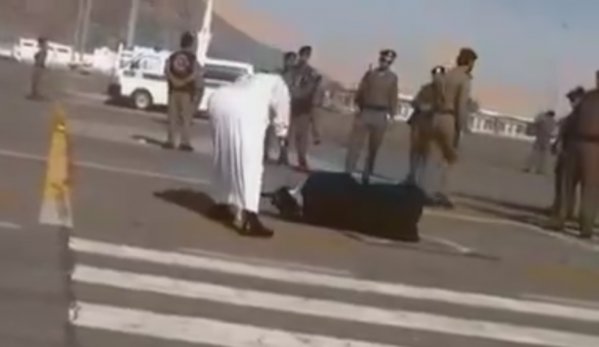
| Public execution in Saudi Arabia |
Ayed al-Jahdali was executed in the Makkah region, the interior ministry said.
Saudi executions are usually carried out by beheading with a sword although sometimes a firing-squad is deployed.
A total of 151 people have been executed in Saudi Arabia this year -- the highest recorded figure since 1995 -- campaign group Amnesty International said in a statement, condemning the "bloody execution spree".
"The Saudi Arabian authorities appear intent on continuing a bloody execution spree which has seen at least 151 people put to death so far this year -- an average of 1 person every 2 days," said James Lynch, deputy director of Amnesty International's Middle East and North Africa Programme.
Almost 1/2 of the 151 executions were for offences that do not meet the threshold of "most serious crimes" which involve intentional killing and for which the death penalty can be imposed under international human rights law, Amnesty said.
The death penalty is disproportionately used against foreigners in Saudi Arabia and of the 63 people executed this year for drug-related charges, 45 were foreign nationals, the group said.
So far 71 foreign nationals have been put to death in the conservative kingdom in 2015, mostly migrant workers from developing countries, Amnesty said.
Rights experts have raised concerns about the fairness of trials in the kingdom and migrants are especially vulnerable as they typically lack knowledge of Arabic and are denied adequate translation during their trials, Amnesty noted.
"The use of the death penalty is abhorrent in any circumstance but it is especially alarming that the Saudi Arabian authorities continue to use it in violation of international human rights law and standards, on such a wide scale, and after trials which are grossly unfair and sometimes politically motivated," said James Lynch.
The country's Supreme Court has upheld the death sentence of Sheikh Nimr Baqir al-Nimr, a prominent Shia Muslim cleric after a politicised and grossly unfair trial at Saudi Arabia's notorious counter-terror court.
Nimr's nephew Ali Mohammed Baqir al-Nimr, and 2 other young Shia activists who were arrested as juveniles after taking part in anti-government rallies, also had their death sentences upheld, Amnesty said.
All 3 claim they were tortured and denied access to a lawyer during their trials.
Source: Business Standard, November 10, 2015
Where's the Outrage Over the Beheadings in Saudi Arabia?
By the time you read this column, Ali Mohammed al-Nimr, Dawoud Hussein al-Marhoon and Abdullah Hasan al-Zaher may be dead.
In case you've never heard their names, they are young prisoners of conscience currently housed in solitary confinement at the notorious al-Ha'ir penitentiary in Riyadh, Saudi Arabia. They are waiting to be beheaded. In all likelihood, as is Saudi custom, no advance public notice of their executions will be given. We'll learn of their demise only after the fact, via social media, or when the Saudi government officially announces that their sentences have been carried out.
Al-Nimr, al-Marhoon and al-Zaher are Shiite Muslims who were arrested without warrants at different times in 2012 for participating in pro-democracy protests in the country's Eastern province during the Arab Spring uprising of 2011-2012. Al-Nimr and al-Marhoon were 17 years old when they were apprehended; al-Zaher was 16.
Although approximately 90 % of the Saudi population consists of Sunni Muslims, the oil-rich Eastern province is predominantly Shiite. Relations between the 2 strands of Islam have never been good in Saudi Arabia, but tensions have reached a fever pitch in recent years. Branded as apostates by prominent Sunni clerics, the Shiites of Saudi Arabia are an oppressed and segregated minority, historically excluded from access to government services, jobs and leadership positions and often subject to arbitrary arrest and imprisonment.
Al-Nimr and his cohorts were held for more than 2 years in pretrial detention without access to counsel while they were interrogated and reportedly tortured into signing confessions. Their alleged crimes, according to Amnesty International, included "chanting slogans against the State with the intent of destabilizing the security of the country and overturning its system of government, participating in the killing of police officers by making and using Molotov cocktails to attack them" and "carrying out an armed robbery."
Their trials were devoid of the most basic due-process protections. Predictably, in 2014 all three were convicted and sentenced by the nation's Specialized Criminal Court in Riyadh to death by beheading. Their convictions and sentences were subsequently upheld on appeal.
The only difference in the outcome of the 3 cases is that al-Nimr won't just have his head lopped off. His body will be crucified afterward and put on public display as a warning to other would-be troublemakers. Al-Nimr is the nephew of a leading Shiite spiritual figure - Sheikh Nimr Baqir al-Nimr - who is also under a death sentence for his vocal criticism of the monarchy, the House of Saud, which has exercised absolute rule over its people since 1932.
Saudi Arabia is one of the last nations on earth that stage public executions. "They are carried out not just in Riyadh, but in other cities," Neil Hicks of Human Rights First (HRF) told me in an interview last week. "In Riyadh, they generally take place after Friday prayers in a downtown courtyard known locally as 'Chop Square,' when crowds of men are already gathered in the area and provide a ready audience."
Beheading is the most common method of execution, but other means, such as firing squads, are occasionally used. Amnesty International reports that in 2014, the Saudis executed 90 people. This year, through Oct. 22, the number has soared to 137. Apart from China and Iran, no other country consistently exceeds such totals.
Hicks, who formerly worked as a researcher for the Middle East department of Amnesty International in London before becoming director of human rights promotion at the HRF in New York, says the spike in the Saudi death penalty is part of a general "clampdown on human rights" that has taken place over the last 3 to 4 years "because the regime is concerned with the impact of the Arab Spring" and "threats to authoritarian rule." Public beheadings, he explains, are "meant to keep order and suppress dissent."
Coerced confessions like those extracted from al-Nimr, al-Marhoon and al-Zaher are a staple of the Saudi justice system, as are closed trials and appeals. Equally deplorable is the fact that capital crimes are vaguely defined, ranging from murder and drug smuggling to adultery, apostasy, witchcraft and sorcery. From 2014 through the middle of this year, nearly 1/2 of those sent to the sword had been convicted of nonlethal, drug-related crimes.
The Saudi system of executing juveniles also violates international law, specifically the United Nations Convention on the Rights of the Child. Even the United States - which along with Japan is the last advanced Western-style democracy that regularly implements capital punishment - has halted the execution of juvenile offenders as a result of a 2005 Supreme Court decision (Roper v. Simmons) declaring the practice unconstitutional.
Women and the mentally disabled, too, are subject to the Saudi death penalty. In one particularly loathsome case, Rizana Nafeek - a Sri Lankan woman who had worked as a domestic servant - was beheaded in Dawadmi, a small town 200 miles west of Riyadh, for causing the death of a 4-month-old baby in her care. Nafeek claimed the child choked while being bottle-fed. Once in custody, she "confessed" - without the assistance of a lawyer or interpreter - to strangling the infant. The opening stages of Nafeek's execution were filmed and are available for viewing on YouTube.
In the face of such medieval barbarity, where is the outrage?
To be sure, international human rights organizations have worked hard to expose the Saudi atrocities. Thus far, however, their pleas to dismantle the Saudi killing machine have proved ineffective.
Most shamefully, the Obama administration has declined to speak out. Although the president has frequently condemned the gruesome beheadings performed by Islamic State, he has remained mum on Saudi practices.
When White House press secretary Josh Earnest was asked by a reporter in a Sept. 23 media briefing to comment on the al-Nimr case, he claimed not to be "familiar with the intimate details of ... the situation." Earnest quickly added, however, "that the United States, under the leadership of this president, regularly raises our concerns about the human rights situation inside of Saudi Arabia."
But even if the U.S. is indeed employing back channels of diplomacy to halt at least some of the Saudi executions, such efforts are grossly inadequate and also hypocritical. "The Saudi practices of public beheadings," Hicks says, "are the pattern that has been followed by [Islamic State] to terrify and subdue subject populations. This is where [Islamic State] gets its message from. The Saudis have been doing the exact same thing for decades."
The U.S. refusal to condemn Saudi human rights violations is rooted, of course, in larger geopolitical machinations. Despite the recent drop in global commodity prices, the Saudis remain a critical supplier of crude oil to the West. Even more critically, the Saudis are viewed as a vital American military ally - 2nd only to Israel in the Middle East - in the all-purpose and never-ending war on terror.
Since October 2010, according to the Congressional Research Service, the Saudis have purchased more than $90 billion in fighter aircraft, helicopters, missile defense systems, missiles, bombs, armored vehicles and related equipment from such American defense manufacturers as Raytheon, Boeing and Lockheed Martin. Since March of this year, U.S.-trained Saudi military personnel have deployed such equipment to launch a vicious air-bombardment campaign against Shiite Houthi rebel groups in Yemen.
Although the Obama administration lacks the courage and decency to come forward, the rest of us have no reason to be constrained. Campaigns to free al-Nimr and his compatriots confined on Saudi Arabia's death row are underway and deserve our active participation.
The 1st step in ending tyranny is to expose its existence - to let the tyrants know that we're watching and won't turn away until they are forced to change their ways or stand down once and for all.
Source: truthdig.com, Bill Blum, November 10, 2015
Related content:
- Execution caught on video in Saudi Arabia, Emirates 24/7, June 3, 2012
- Saudis behead, crucify Sudanese man for robbery, rape and murder, Apr 21, 2012
- Saudi Arabia executes Burmese woman; secret filming reveals medieval, barbaric punishment, January 12, 2015