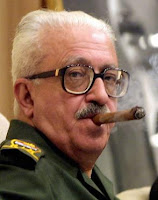
Iraqi leader under Saddam Hussein to be executed, official in Baghdad says

Tariq Aziz
Baghdad (CNN) -- Tariq Aziz, who served as Iraq's top diplomat under Saddam Hussein, will be executed next year, after U.S. forces have pulled out of the country, an adviser to Iraq's prime minister told CNN on Monday.

"It will definitely take place, and it will take place after the Americans leave Iraq," said the adviser, Saad Yousif al-Muttalibi, about Aziz, who served as foreign minister.

A lawyer for Aziz said he was surprised. "I did not expect the government would be that stupid, by doing this they will drag this country to the edge of the abyss," said Badi Arif in a telephone interview.

"What about the national reconciliation that this government has been calling for? The government's position will be even weaker if they carry out the execution after the American troops leave the country and this will lead to more conflict among Iraqi factions."

A new law is under consideration that would require death sentences be ratified by the president within 15 days of their being handed down, al-Muttalibi said.

Al-Muttalibbi added that all of Iraqi society, including members of the three main sectarian groups -- Sunnis, Shiites and Kurds -- favor the law.

Aziz was captured by U.S. forces in April 2003, shortly after the U.S.-led invasion that toppled Hussein. He appeared frail when he testified in Hussein's 2006 trial on war crimes charges, for which the ousted dictator was hanged later that year.

Aziz was sentenced to death in October 2010 by the Iraqi High Tribunal for his role in eliminating religious parties during Hussein's regime.

His family was shocked by the verdict, his daughter told CNN at the time.

"My father served his country for more than 22 years. He delivered himself to the U.S. Army (after the fall of Hussein) because he wasn't afraid. He didn't do anything wrong. He served his country," Aziz's daughter, Zainab Aziz, said. "He has been wronged."

Arif said last year that there was a political motive behind the death sentence.

"Mr. Aziz used to always tell me, 'They'll find a way to kill me, and there is no way for me to escape this,'" Arif told CNN. "But from a legal perspective, this sentence is wrong; this is illegal and this is unexpected."

Aziz served as deputy prime minister from 1981 to 2003, also holding the post of foreign minister for part of that time.

After the verdict was announced, Amnesty International urged Iraq not to carry out the sentences, even as it acknowledged the brutality of Hussein's regime.

"Saddam Hussein's rule was synonymous with executions, torture and other gross human rights violations, and it is right that those who committed crimes are brought to justice," said Malcolm Smart, Amnesty International's director for the Middle East and North Africa in 2010.

"However, it is vital that the death penalty, which is the ultimate denial of human rights, should never be used, whatever the gravity of the crime," he said in a written statement.

The Vatican also opposed the death sentence, spokesman Federico Lombardi told CNN.

"This is not the most adequate way to promote reconciliation and reconstruction of justice and peace in a country that has suffered so much," he said.

Source: CNN, December 6, 2011

Related articles:
Jun 11, 2011
June 9, 2011: Sentenced to hang in Iraq, Saddam Hussein's ex chief of diplomacy Tareq Aziz has serious health problems and does not want to die in jail. His son Ziad asked the Iraqi government to put an end to his suffering....
Oct 26, 2010
The death sentence is the first for Aziz, who is already serving a 15-year prison sentence for the execution of 42 merchants in 1992. He was sentenced to another seven years for the forced displacement of Kurds in northern ...
Nov 29, 2010
Aziz was spared the death penalty in the Saddam-era crimes against humanity because he had a lesser involvement in the atrocities than some of his co-defendants, said Mohammed Abdul-Sahib, a spokesman for the Iraqi ...

Comments

Most viewed (Last 7 days)

Tennessee executes Harold Wayne Nichols

Thirty-seven years after confessing to a series of rapes and the murder of Karen Pulley, Nichols expressed remorse in final words Strapped to a gurney in the execution chamber at Riverbend Maximum Security Institution Thursday morning, Harold Wayne Nichols made a final statement.  “To the people I’ve harmed, I’m sorry,” he said, according to prison officials and media witnesses. “To my family, know that I love you. I know where I’m going to. I’m ready to go home.”

China | Former Chinese senior banker Bai Tianhui executed for taking US$155 million in bribes

Bai is the second senior figure from Huarong to be put to death for corruption following the execution of Lai Xiaomin in 2021 China has executed a former senior banker who was found guilty of taking more than 1.1 billion yuan (US$155 million) in bribes. Bai Tianhui, the former general manager of the asset management firm China Huarong International Holdings, was executed on Tuesday after the Supreme People’s Court approved the sentence, state broadcaster CCTV reported.

Burkina Faso to bring back death penalty

Burkina Faso's military rulers will bring back the death penalty, which was abolished in 2018, the country's Council of Ministers announced on Thursday. "This draft penal code reinstates the death penalty for a number of offences, including high treason, acts of terrorism, acts of espionage, among others," stated the information service of the Burkinabe government. Burkina Faso last carried out an execution in 1988.

Who Gets Hanged in Singapore?

Singapore’s death penalty has been in the news again.  Enshrined in law in 1975, a decade after the island split from Malaysia and became an independent state, the penalty can see people sentenced to hang for drug trafficking, murder or firearms offenses, among other crimes. Executions have often involved trafficking under the Misuse of Drugs Act, with offenses measured in grams.  Those executed have included people from low-income backgrounds and foreign nationals who are sometimes not fluent in English, according to human rights advocates such as Amnesty International and the International Drug Policy Consortium. 

Oklahoma board recommends clemency for inmate set to be executed next week

A voting board in Oklahoma decided Wednesday to recommend clemency for Tremane Wood, a death row inmate who is scheduled to receive a lethal injection next week at the state penitentiary in McAlester.  Wood, 46, faces execution for his conviction in the 2001 murder of Ronnie Wipf, a migrant farmworker, at an Oklahoma City hotel on New Year's Eve, court records show. The recommendation was decided in a 3-2 vote by the Oklahoma Pardon and Parole Board, consisting of five members appointed by either the governor or the state's top judicial official, according to CBS News affiliate KWTV. Oklahoma Gov. Kevin Sitt will consider the recommendation as he weighs whether to grant or deny Wood's clemency request, which would mean sparing him from execution and reducing his sentence to life in prison without the possibility of parole.

Iran | Child Bride Saved from the Gallows After Blood Money Raised Through Donations, Charities

Iran Human Rights (IHRNGO); December 9, 2025: Goli Kouhkan, a 25-year-old undocumented Baluch child bride who was scheduled to be executed within weeks, has been saved from the gallows after the diya (blood money) was raised in time. According to the judiciary’s Mizan News Agency , the plaintiffs in the case of Goli Kouhkan, have agreed to forgo their right to execution as retribution. In a video, the victim’s parents are seen signing the relevant documents. Goli’s lawyer, Parand Gharahdaghi, confirmed in a social media post that the original 10 billion (approx. 100,000 euros) toman diya was reduced to 8 billion tomans (approx. 80,000 euros) and had been raised through donations and charities.

Afghanistan's Taliban rulers carry out public execution in sports stadium

The man had been convicted of killing 13 members of a family, including children, and was executed by one of their relatives, according to police. Afghanistan's Taliban authorities carried out the public execution of a man on Tuesday convicted of killing 13 members of a family, including several children, earlier this year. Tens of thousands of people attended the execution at a sports stadium in the eastern city of Khost, which the Supreme Court said was the eleventh since the Taliban seized power in 2021 in the wake of the chaotic withdrawal of US and NATO forces.

Afghanistan | Two Sons Of Executed Man Also Face Death Penalty, Says Taliban

The Taliban governor’s spokesperson in Khost said on Tuesday that two sons of a man executed earlier that day have also been sentenced to death. Their executions, he said, have been postponed because the heir of the victims is not currently in Afghanistan. Mostaghfer Gurbaz, spokesperson for the Taliban governor in Khost, also released details of the charges against the man executed on Tuesday, identified as Mangal. He said Mangal was accused of killing members of a family.

Utah | Ralph Menzies dies on death row less than 3 months after his execution was called off

Judge was set to consider arguments in December about Menzies’ mental fitness  Ralph Menzies, who spent more than 3 decades on Utah’s death row for the 1986 murder of Maurine Hunsaker, has died.  Menzies, 67, died of “presumed natural causes at a local hospital” Wednesday afternoon, according to the Utah Department of Corrections.  Matt Hunsaker, Maurine Hunsaker’s son, said Menzies’ death “was a complete surprise.”  “First off, I’d say that I’m numb. And second off, I would say, grateful,” Hunsaker told Utah News Dispatch. “I’m grateful that my family does not have to endure this for the holidays.” 

Iran carries out public hanging of "double-rapist"

Iran on Tuesday publicly executed a man after convicting him of raping two women in the northern province of Semnan. The execution was carried out in the town of Bastam after the Supreme Court upheld the verdict, the judiciary's official outlet Mizan Online reported. Mizan cited the head of the provincial judiciary, Mohammad Akbari, as saying the ruling had been 'confirmed and enforced after precise review by the Supreme Court'. The provincial authority said the man had 'deceived two women and committed rape by force and coercion', adding that he used 'intimidation and threats' to instil fear of reputational harm in the victims.