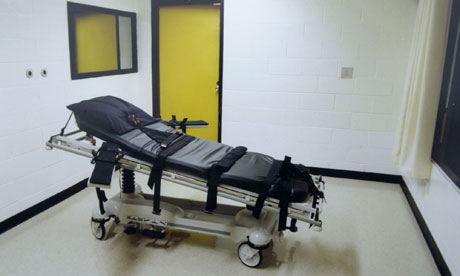
John Duty: human guinea pig in Oklahoma's cruel experiment

When Texas first used lethal injection on 7 December 1982, it was meant to usher in an era of a kinder, gentler method of capital punishment. "Fry 'em" or "String 'em up" used to be the harsh mottos of the executioner, but after the horrors of the electric chair and the gallows, some hoped that nobody would find the needle so objectionable.

Some find it counterintuitive that an anaesthetic can cause pain during an execution, but if the anaesthetic does not work, then the prisoner is first paralysed and then poisoned in a particularly painful way. Unfortunately, the probability of such a mistake is very high, no matter what the drug the executioner may use.

Doctors' ethics prohibit them from taking part in an execution, so the prison must ask one of its employees to mix up the drugs, and then "administer" them. This helps to explain why postmortems in the three most recent executions in Tennessee show insufficient anaesthetic in the prisoner's bloodstream: he was not rendered unconscious. He did not die the painless death that the executioners advertised, but slowly suffocated as the other drugs took effect, an excruciating death.

Oklahoma has chosen to turn to the vets for help. They have asked the court for permission to execute John Duty on 16 December – just in time for Christmas – with [pentobarbitol], the drug the vets currently use to kill dogs. This is, they suggest, a kindness. Unfortunately, they have found a judge in Oklahoma to agree with them.

As ever, it is not that simple. Drugs that work for animals may or may not have the same effect on humans. So, John Duty would become a human guinea pig, and we'll just have to see how much he suffers.

Click here to read the full article.

Related story and update: 'Oklahoma executes John Duty with drug used to euthanize animals', Dec. 17, 2010

Source: Clive Stafford Smith, guardian.co.uk, Tuesday 23 November 2010

Comments

Most viewed (Last 7 days)

Florida executes Harold Gene Lucas

Florida state officials executed 74-year-old Harold Gene Lucas by lethal injection on Tuesday evening, concluding a 50-year legal saga stemming from the 1976 murder of a 16-year-old girl in Bonita Springs. STARKE, Fla. -- A man convicted of killing a teenage girl who rejected his romantic advances and wounding two of her friends was put to death Tuesday in the first of three executions planned this month in Florida. Harold Gene Lucas, 74, was pronounced dead at 6:18 p.m. following a three-drug injection at Florida State Prison near Starke, authorities said. He was sentenced to death for the 1976 shooting attack on Jill Piper and the wounding of her friends, Richard Byrd Jr. and Terri Rice.

He Spent 27 Years on Death Row as a Wrongfully Convicted Man. What Comes Next?

23-hour solitary confinement. 115-degree heat. Jimmie Duncan is haunted by the decades he spent in Louisiana’s Angola Prison—and how, even after being released, he still isn’t truly free. Jimmie “Chris” Duncan wiped the sweat off his forehead as he assessed his temporary home from the parking lot of a rundown motel in central Louisiana. Sure, there’s drug dealing and prostitution, he said on a recent summer afternoon. And he suspected his neighbors were cooking meth on a floor below the room he paid $350 a week to rent.

Ex-corrections officials urge governor to commute Kansas death sentences

Former Kansas corrections officials are urging Governor Laura Kelly to grant clemency to the state's death row inmates. Former Kansas Corrections Secretary Roger Werholtz has several reasons why he thinks the state should abolish the death penalty. Werholtz, who served as secretary from 2002 to 2010 and returned on an interim basis in 2019, uses his discussions with peers and family members of victims as well as experiences of seeing wrongly convicted people getting exonerated as his guiding points.

Arizona AG seeks execution date for man convicted in 1995 trooper killing

Trooper Bob Martin was killed during a traffic stop on the Beeline highway; execution for his killer could be as soon as January PHOENIX (AZFamily)—The Arizona Attorney General is asking for an execution date to be set for a man convicted in the killing of an Arizona State Trooper over 30 years ago. On Aug. 15, 1995, Trooper Bob Martin was shot and killed while performing a traffic stop along the Beeline Highway.

Iran Crackdown on Christians Intensifies, Ministry Reports Dozens Killed and Hundreds Detained

September 3, 2026: A widening crackdown on Christians in Iran has reportedly resulted in the deaths of at least 33 Christian ministers and the detention of more than 130 others in recent months, according to Iran Alive Ministries, a Texas-based organisation supporting underground house churches in the country. Hormoz Shariat, founder of Iran Alive Ministries, told Baptist Press that at least 33 Christian ministers associated with the ministry had been killed amid intensified government pressure on Christians linked to the underground church movement.

Florida set to carry out 14th execution this year in the nation's busiest death chamber

MIAMI (AP) — A Florida man convicted of fatally shooting a 16-year-old girl who rejected his romantic advances and wounding two of her friends is set to be executed Tuesday in the first of three lethal injections scheduled this month in the state. Harold Gene Lucas, 74, is set to receive a three-drug injection at Florida State Prison near Starke starting at 6 p.m. He would be the 14th prisoner put to death this year in Florida, and Republican Gov. Ron DeSantis has already signed death warrants for two more executions set for later this September.

Egypt TV presenter and 11 others sentenced to death in major drugs case

Egyptian television presenter Sarah Khalifa and 11 others have been sentenced to death by hanging after being convicted of drug trafficking and rape, while nine defendants received life sentences and seven were acquitted. Egyptian television presenter Sarah Khalifa, 39, has been sentenced to death by hanging along with 11 other defendants after being found guilty in a drugs case involving a criminal gang accused of importing ingredients used to manufacture narcotics for sale.

Indiana high court sets Nov. 5 execution date for convicted child killer

The court’s decision came a little more than two months after Indiana Attorney General Todd Rokita asked the justices to schedule Weisheit’s execution. State attorneys argued Weisheit had exhausted his state and federal appeals, had no active stay of execution, and could lawfully be put to death. The inmate’s attorneys opposed setting a date, saying they needed more time to pursue available legal proceedings and possible executive clemency. The defense additionally pointed to public records that it said showed the Indiana Department of Correction lacked the drugs needed to conduct an execution and had no lawful source from which to obtain them.

Oklahoma Sets November Execution Date for Air Force Veteran Jim Pavatt Amid Claims of Wrongful Conviction

OKLAHOMA CITY — The Oklahoma Court of Criminal Appeals has scheduled the execution of Air Force veteran and longtime death row prisoner Jim Pavatt for Nov. 12, as his attorneys continue to challenge his conviction and contend that prosecutors relied on false arguments, disputed forensic evidence and an alleged confession they later described as bogus. Pavatt, who served nearly 22 years in the Air Force and rose to the rank of master sergeant, was convicted and sentenced to death for the 2001 killing of Rob Andrew in Oklahoma City. His execution is scheduled for the day after Veterans Day.

Hanging, confinement and the sentencing debate India won’t have

Ask anybody what a “death sentence” in India actually means, and the honest answer is that it can mean three quite different things. It can mean the noose—hanging by the neck until death; it can mean permanent confinement in jail—a term the courts now call imprisonment for the remainder of one’s natural life, and, far more often than either of the first two, it can simply mean delay in delivery of justice—a death sentence that is neither carried out nor commuted, waiting for completion of investigation, trial before the sessions court, hearing of a confirmation proceeding in a high court, appeal against conviction in the Supreme Court, or hearing of a mercy petition nobody has decided for years, sometimes for decades, until age or illness does what the state never got around to doing itself.