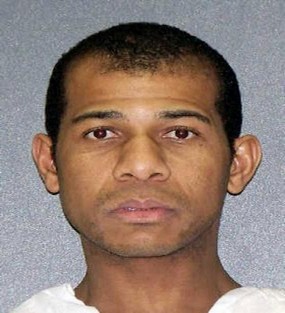
Texas executes Dale Devon Scheanette

Dale Devon Scheanette
A Louisiana man condemned for strangling and drowning a suburban Dallas woman, charged with the slaying of a 2nd and blamed for the rapes of at least five other women was executed Tuesday evening.

Asked if he had any final statement, Dale Devon Scheanette paused and said, "My only statement is that no cases ever tried have been error free. Those are my words. No cases are error free."

Scheanette then told the warden he could proceed. He selected no witnesses for his death. 6 relatives of his 2 murder victims watched as he took his final breath. He never looked at them.

9 minutes after the lethal drugs began to flow, he was pronounced dead at 6:21 p.m.

Scheanette, 35, became known as the "Bathtub Killer" after 2 women at the same apartment complex in Arlington in 1996 were found dead in half-filled bathtubs, strangled, raped and bound with duct tape.

He was sent to death row for the Christmas Eve 1996 slaying of Wendie Prescott, 22, and charged but not tried for killing Christine Vu, 25, 3 months earlier.

Scheanette, acting as his own lawyer, had appeals rejected Monday in the federal appeals courts. The Texas Board of Pardons and Paroles also voted 7-0 to turn down a clemency request.

A woman identifying herself as Scheanette's sister filed a three-page handwritten motion on his behalf Tuesday with the U.S. Supreme Court seeking a reprieve so he could get a court review of the appeals rejected Monday. The high court turned down the appeal less than an hour before Scheanette was scheduled to die.

The slayings that terrorized the suburban Dallas-Fort Worth area went unsolved for more than three years because detectives couldn't match a fingerprint at the murder scenes to anyone in criminal databases. Finally, in 1999, Scheanette was arrested for a burglary outside Dallas and his prints were tied to the killings. DNA then strengthened the confirmations and also pointed to his involvement in the other rapes.

"He personifies evil," said Greg Miller, the Tarrant County district attorney who prosecuted Scheanette in 2003. "I've been doing this 35, 36 years. I've had others who have killed and done bad things. But he's at the top of the list."

Prosecutors and defense lawyers said it was uncertain what set Scheanette off. Evidence showed that at some time before the Prescott and Vu killings, the native of Ouachita Parish in northern Louisiana had lived at the apartment complex where both women lived and died.

Scheanette declined to speak with reporters as his execution date neared. At his trial, lawyers tried to show the evidence was insufficient to convict him.

"We brought in his family to show he had a pretty good family unit and that he got along well," said J.R. Molina, his trial attorney. "The DNA evidence, the fingerprint evidence that came in, were very strong. Several other instances of burglary, break-ins and rapes that he committed, that was pretty strong evidence to show to a jury."

Prescott's aunt and uncle, concerned when she failed to show up for a shopping trip with her sister, went to her apartment and found her dead.

"I hope he asks God to forgive him and save his soul," Brenda Norwood, Prescott's aunt, told The Dallas Morning News. "I had to forgive because I can't live like that. I can't hate him for what he did because that would not bring Wendie back. You have to move on."

After jurors convicted him of capital murder for the Prescott slaying, prosecutors in the punishment phase of the trial called to the witness stand 5 women who testified how they were beaten, threatened and raped by Scheanette.

"I am convinced that testimony of those 5 women was very therapeutic for them," Miller said, describing the women as crying and hugging 1 another after leaving the witness stand. "It was a pretty moving event. ... It was a miracle he didn't kill any of the other women."

Miller, however, said he was left to wonder how many others Scheanette may have raped or killed.

"The possibility certainly exists," said Tommy LeNoir, the Arlington homicide detective who investigated the slayings. "I will tell you this, without reservation, that the right person is in this position, that the person who took the lives of these 2 ladies, I have absolutely no reservation that the person responsible is Dale Scheanette."

Scheanette becomes the 7th condemned inmate to be put to death this year in Texas and the 430th overall since the state resumed capital punishment on December 7th, 1982. Scheanette becomes the 191st condemned inmate to be put to death since Rick Perry became governor in 2001.

On Thursday, another inmate linked to multiple slayings and rapes was set to die. Johnny Ray Johnson, 51, was convicted of the 1995 rape-slaying of Leah Joette Smith, whose head was slammed repeatedly into a cement street curb in Houston after she refused to have sex with him.

Scheanette becomes the 10th condemned inmate to be put to death this year in the USA and the 1146th overall since the nation resumed executions on January 17, 1977.

Sources: Associated Press, Rick Halperin, Feb 11, 2009

Most viewed (Last 7 days)

USA | What happens in the final weeks before an execution? These reporters were inside the room.

The journalists behind ‘The Last 12 Weeks’ earned extraordinary access to a death penalty defense team—and faced difficult ethical choices Many defense lawyers are naturally cagey. They work in a pressure cooker, protecting their clients’ rights while fighting for the best possible outcome. And arguably, the stakes can’t get any higher than trying to save a client’s life. So no, defense lawyers don’t usually invite journalists into strategy meetings. But that’s what happened when Marshall Project reporter Maurice Chammah and Serial Productions senior producer Alvin Melathe spent the final few months before a Texas execution embedded with a capital defense team.

North Korea | 'I was only 9': North Korean defector recalls childhood memory of public execution

Kim Eun-joo was 9 years old when her teacher stopped their lesson and told the class to follow her outside. The children were marched to a public execution ground in North Korea. “I would cry even when our family dog died,” Kim said in a recent interview with The Korea Times. “But the first time I watched humans killing a human, I had no words for what I was feeling. It was the most brutal scene I have ever seen, in any movie or in real life.” The memory has stayed with her ever since. Now a human rights advocate after defecting from North Korea, Kim recently brought that childhood scene to the 9th World Congress Against the Death Penalty in Paris, where North Korea’s use of public executions and capital punishment was officially placed on the agenda for the first time.

19 July 1943 | Auschwitz's Largest Public Hanging: 12 Polish Prisoners Executed in Escape Reprisal

OSWIECIM, Poland — The SS carried out the largest public hanging in Auschwitz history on July 19, 1943, executing 12 Polish prisoners before other inmates as collective punishment for escapes and civilian contacts. The victims, all from the camp’s surveyors’ labor unit, were hanged on gallows built in front of the camp kitchen during an Auschwitz I roll call. The SS orchestrated this reprisal following prisoner escapes from the surveyors’ detail and unauthorized communication between inmates and civilians. Camp authorities used the recent escapes as a pretext to impose collective punishment.

Japan: Capital punishment for a minor

Death chamber at Tokyo Detention Center The Supreme Court's recent decision to uphold the death sentence given in a lay judge trial to a 24-year-old man for murders he committed when he was a minor raises questions about the lay judge trial system and capital punishment. These include whether the lay judges correctly understood the spirit of the Juvenile Law in sentencing the defendant to death. It was the 1st death sentence handed down on a minor in a lay judge trial. The murders took place in Ishinomaki, Miyagi Prefecture, in 2010 when Yutaro Chiba was 18 - meaning he fell under the purview of the Juvenile Law. Chiba was convicted of entering his ex-girlfriend's house and stabbing to death the girl's sister and a female friend of the girl with a butcher knife, seriously injuring a male friend of the sister and abducting the girl. Prosecutors said Chiba killed the victims because they were trying to separate him and his former girlfriend. Since Chiba pleaded n...

Texas: The inmates who refused to die quietly and had to be gassed out of their cells before execution

Former crime reporter Michelle Lyons, who witnessed nearly 300 executions in Texas, US, reveals the desperate acts of death row prisoners who refused to accept their fate After spending years or often decades locked up in a tiny cell for 23 hours a day, most Death Row inmates go willingly to their executions. However, some refuse to die quietly - with officers forced to gas them out of cells, strap up their heads and even give chase across prison grounds. Michelle Lyons, who has witnessed nearly 300 executions in Texas, US, exclusively tells Sun Online how certain inmates "fight like hell" in their last moments. On most occasions, Michelle watched from the witness area, with the killers already on the gurney - the stretcher where they'd be given a lethal injection. Seven prisoners once tried to escape from the Row in Huntsville - with one shoving magazines and newspapers under his clothes to help him roll over razor-wire fences. Others have had to b...

Former Florida cop to be executed on same day as 80-year-old Pasco man

In an unprecedented move in the modern history of capital punishment, Gov. Ron DeSantis on Tuesday cleared the way for 2 executions to occur on the same day.  DeSantis reset the execution of James Duckett, whose execution earlier this year was stayed amid efforts to secure DNA testing and analysis of evidence in his case.  Duckett’s execution was reset for July 28. That is the same day previously set for the execution of Dominick Occhicone.  Court records indicate that Duckett’s execution is scheduled for noon. Occhicone’s is set to follow at 6 p.m. 

Idaho | Death row prisoners sue over state's new firing squad

BOISE (Idaho Statesman) – Days after Idaho made the switch to a firing squad for executions, two Idaho death row prisoners next in line to be put to death sued the state prison system, saying its director withheld information about how she settled on the specifics for carrying out the method. Attorneys for prisoners Thomas Creech and Gerald Pizzuto filed suit this week in state district court against Idaho Department of Correction Director Bree Derrick. In the filing, they called her approval of an updated standard operating procedure for the firing squad and lethal injection as a backup method “arbitrary, capricious, or an abuse of discretion and in excess of the statutory authority of the agency.”

Florida executes Dennis Sochor

Man, 74, becomes oldest inmate executed in Florida in state’s 10th lethal injection this year  Florida put to death one of its oldest prisoners in its history on Tuesday, a 74-year-old convicted murderer who was 1 of 3 older inmates scheduled for execution within the span of a month in the nation’s busiest death penalty state.  Dennis Sochor was pronounced dead at 6:16 p.m. following a 3-drug injection at Florida State Prison near Starke, the office of Republican Gov. Ron DeSantis said. He was convicted of killing a woman on Jan. 1, 1982, just hours after meeting her at a New Year’s Eve party. 

Oldest inmate set to be executed in Florida will face strict spending limit for final meal

An entire category of food is also off-limits for final meal requests in Florida Florida is currently preparing to execute its oldest inmate later today (July 14), a 74-year-old convicted murderer who has been on death row since the 1980s—but his final meal will be limited by a strict budget. Dennis Sochor is scheduled to be put to death later today, making history as the oldest inmate to ever be executed in the state. The criminal, who has been on death row for nearly 40 years, will be administered the lethal three-drug injection, with the process due to begin at around 6pm.

Florida | Former warden recalls botched electrocution that left him battling PTSD for 13 years and turned him into an abolitionist

Ron McAndrew anticipated it would be just another standard execution. He had been assigned to carry out the death of Cuban refugee Pedro Medina via electric chair within the confines of Florida State Prison. Fifteen years had passed since Medina's conviction for the murder of 52-year-old Dorothy James, and McAndrew's responsibility was to oversee the administration of lethal electrical currents to his brain. Having already supervised two previous executions using the identical procedure and raised in a community that strongly supported capital punishment, he expected a swift conclusion with justice delivered.