
Currently in his 70s, a Japanese man who worked as a prison guard for many years at a detention center in eastern Japan, remains anonymous for privacy reasons.
One morning in the 1990s, he was informed he was to be that day's "noose handler," assisted by four other prison officers and several staff in the task of hanging death row inmates.
"I knew this was a road I'd have to go down eventually if I worked at a detention center," the man said in an interview with Kyodo News. "You don't have any power to veto the decision."
In Japan, more than 80 percent of people surveyed by the Cabinet Office believe "the death penalty is unavoidable." However, there have been no executions in nearly three years.
 "I think I would have been more comfortable with tying the feet than hanging a noose around their necks. I was determined not to embarrass myself. I didn't tremble," he recalled.
 There is no Japanese law requiring prior notice of executions, but it is believed that until at least the 1970s, inmates were informed by the day before. Today, they are typically notified only one to two hours before the execution.
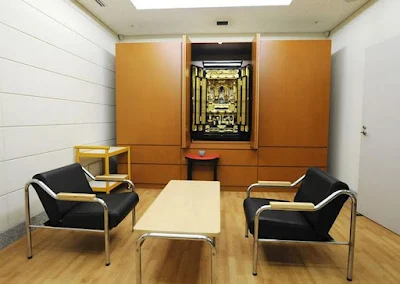
 In photos of the Tokyo Detention House released in 2010 via the media, the execution chamber could almost pass for a conference room with bright wood paneling, except for the very conspicuous apparatus used to carry out the sentence in the middle of the room.
 In October 2024, Hakamada, who had been sentenced to death for the 1966 murders of a family of four in Shizuoka Prefecture, central Japan, was acquitted in a retrial, highlighting issues such as the protracted nature of the retrial system and the risk of wrongful convictions in capital cases.
 "Some of them are practically serving life sentences. This situation should be sorted out first," he said.
To clarify what actually happens in a Japanese execution, the former prison guard provided his account.
The man explained that the hangman's knot is always placed on the side, never at the back of the neck. This is said to alleviate suffering. Other duties of the staff include tying the inmates' feet.

He said, with the exception of some top officials, prison officers are invariably directly involved in an execution once in their professional lives. Aside from this, the man also witnessed the proverbial "dead man's walk" of a condemned felon being taken to the execution chamber around 40 years ago.
Inmates notified only one to two hours before the execution
That day, an official in charge got the man to release the prisoner from his cell, saying the prisoner had been called by a senior official. From there, the guard saw the prisoner off to the gallows.

Although he had been trained on how to handle condemned prisoners if they resisted, he said, "As far as I'm aware there has never been a person who has put up a fight."
When asked about his overall experience at the detention center, the man said, "I was able to separate my feelings since it was my job. I support the use of the death penalty." However, he added, "I also feel it's not a good thing for the people who actually have to carry it out."
He revealed that every morning when he clasps his hands as a gesture of respect in front of his Shinto and Buddhist altars at home, "The faces of the death row inmates I was involved with flash before my eyes." He does not know why.

It faces a glass partition with blue curtains that open for viewing on the other side by the prosecutor, detention head and other officials who oversee the execution.
For the inmate, there is no choice of a lavish "last meal," though snacks and drinks are provided. They can leave a verbal will.
Inmates are blindfolded and handcuffed behind their backs. In the execution chamber, they are guided to a red square marked on the floor. A thick rope is then slipped around their neck.
At the side blocked by a wall is a "button room" where the executioners do their work. On a signal from a senior official, three prison guards push their buttons simultaneously -- one of the three causing the red square-marked floor to fall open, exposing a hole through which the person falls out of sight and hangs until pronounced dead by a doctor.
Iwao Hakamada
Although there have been no executions in Japan since July 2022, the topic has been widely discussed due mainly to the sad case of Iwao Hakamada.

Hakamada was later awarded about 217 million yen ($1.44 million) in compensation for his nearly 48 years of wrongful imprisonment.
In November 2024, a roundtable on Japan's death penalty system -- a group of legal professionals, parliamentarians and academics -- recommended to the Diet and Cabinet that a public panel be set up to discuss the current capital punishment system.
In an interview with Kyodo News, Satoru Ohashi, 64, former director-general of the Justice Ministry's Correction Bureau, which is responsible for the management of prisons and the treatment of prisoners on death row, suggested that prison officers purposely hide their feelings about executions and simply follow procedure.
"They keep a lid on their feelings and proceed with the execution procedure as if it were a sacred ritual," Ohashi said.
On the death penalty itself, he said, "It is not that I am for or against it, but as long as it is in the system, it must be carried out faithfully. The most important responsibility is to ensure that those who have been sentenced to death are executed."
On the other hand, he also said that "it isn't a job that any official would actively want to do."
The Justice Ministry opened the Tokyo Detention House's execution chamber to media organizations in 2010, when the Democratic Party of Japan was in power. This was the last time it did so, and there has been no response to the roundtable's request for further inspections of the center.
Ohashi takes the position that it is correct to keep the center largely out of public view. "The staff consider it a sacred and inviolable place. There is a psychological resistance to not wanting people to enter."
Death row
The roundtable's report referred to the introduction of a life sentence without the possibility of parole as an alternative to the death penalty. But Ohashi said the reality is that inmates already die -- of natural causes and suicides -- while on death row.

Ohashi, who headed the Correction Bureau from January 2020 to July 2021, believes that "the burden on staff increases even more" as they are required to pay more attention to the treatment of prisoners on death row than in fixed-term sentences.
The roundtable also said the fact that death row inmates are restricted in their contact with people on the outside is a topic that requires further discussion.
Families of victims are not able to contact death row inmates via a communication system set up for the purpose, whereas families can do so if a prisoner was not handed a capital sentence.
Ohashi suggested a coordinator role be considered to connect the two parties in such cases.
The Criminal Procedure Code states that if the justice minister orders an execution, it will be carried out within five days, but the former prison officer pointed out that he does not know how the order of executions is determined, calling it a "black box."
"Some death row inmates have been in detention for so long that they are effectively serving life sentences. If we think about the victims, it is better to carry out the executions in order (of sentences handed down)," he said.
Source: kyodonews.net, Mio Imamura, June 6, 2025





"One is absolutely sickened, not by the crimes that the wicked have committed,
but by the punishments that the good have inflicted."
but by the punishments that the good have inflicted."
— Oscar Wilde
Comments
Post a Comment
Offensive pro-DP comments will not be published.