Lone lawmaker crusades against the death penalty in Alabama

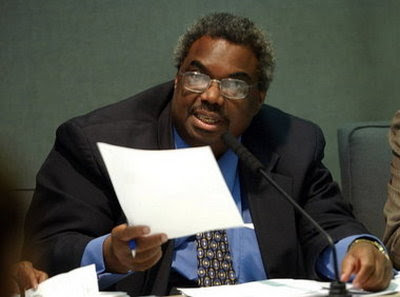
Alabama Senator Hank Sanders
Hank Sanders closed his eyes, pressed his hand to his forehead and tried to recall the first time he petitioned the state of Alabama to abolish the death penalty.

Was it 2000? Or maybe 1998, shortly after the American Bar Association called for a moratorium on capital punishment? The 74-year-old senator from Selma couldn't say for sure, so he asked his secretary to dig into the files.

For nearly two decades, Sanders has introduced bills to end Alabama's ability to take a person's life — an unsuccessful endeavor in a state that has defied national trends away from capital punishment and still houses one of the country's largest death row populations.

Sanders is undeterred, arguing that the death penalty unfairly targets poor African-Americans. Again this year, as he has since 2000, he put forward legislation to stop executions in the Deep South state.

"You don't fight whether you'll win or not," Sanders said in his Montgomery statehouse office. "You fight based on whether you think your position is right."

If past years are an indication, his legislation will again die in committee.

Years ago, Sanders thought he could win support for a three-year pause on executions. When that failed for 12 straight years, he began calling for a full repeal.

"It's a lonely fight," said Sanders, a Democrat in the state Senate since 1983.

An Alabama native, he grew up in a three-room house, the second of 13 children in a rural town during the racial segregation of Jim Crow. The African-American lawmaker has dedicated much of his career to civil rights.

He organized voter registration drives and walked in 1965 with Dr. Martin Luther King Jr. in the Selma-to-Montgomery march that preceded the Voting Rights Act. The private law firm he co-founded doggedly pursued civil rights cases and won more than $1 billion for black farmers who alleged discrimination by the U.S. Department of Agriculture.

Sanders said opposing capital punishment is yet another attempt to bring justice to Alabama.

"It's an extension of my fight for civil rights," he said.

Alabama's 183 death row inmates make that the fourth largest U.S. grouping of prisoners awaiting execution. More than half are black, though African-Americans make up about a quarter of the state's population.

People who study capital punishment say its more frequent application to minorities is linked to racial prejudice. "It is inseparable of historical discussion of race, slavery, lynching, Jim Crow," said Robert Dunham, executive director of the nonprofit Death Penalty Information Center, which opposes capital punishment.

Nationally, the number of yearly executions has dropped dramatically over a quarter century, partly due to difficulty securing lethal injection drugs and waning public support, according to the center. Last year, 20 inmates were put to death, the lowest figure since 1991. Annual death sentencing rates are also down nearly 90 percent since 2000.

Thirty-one states still allow capital punishment, but 10 states account for about 80 percent of the country's total death row population. California, with the largest death row population by far at 749 inmates, has executed only 13 prisoners since 1976, figures from the Death Penalty Information Center show. Alabama has used capital punishment 58 times over the same period.

Sanders said the drop in executions is positive, but he holds out hope for a U.S. Supreme Court ruling outlawing the punishment.

Death penalty advocates say it deters crime and is less costly than life imprisonment. Both sides bicker over conflicting studies on whether it depresses homicide rates.

"At the end of the day, whether you go with Timothy McVeigh or Dylann Roof, the only way you're going to deter people from committing those heinous acts is to have a death penalty," said Republican state Sen. Trip Pittman. He referred to McVeigh, the Oklahoma City bomber executed in 2001, and Roof, recently sentenced to die for a South Carolina church shooting massacre.

People personally affected by vicious crimes said Sanders' attempts to repeal the only punishment that will bring them closure are doing justice a disservice.

"I don't understand why people have all this compassion for these people on death row," said Janette Grantham, executive director of the advocacy group Victims of Crime and Leniency. Her brother, a county sheriff, was murdered in 1979 by a man later handed a life sentence.

Sanders' efforts would make sense in a perfect world, she said, but "it's not a fantasy world to me to want fairness and justice."

Though Sanders' crusade has never gotten far, he insists many lawmakers quietly agree capital punishment should be ended but fear losing votes: "There have been other politicians who have said to me, privately, 'You're right, but I can't touch that.'"

Source: The Associated Press, Anthony Izaguirre, March 15, 2017

⚑ | Report an error, an omission, a typo; suggest a story or a new angle to an existing story; submit a piece, a comment; recommend a resource; contact the webmaster, contact us: deathpenaltynews@gmail.com.


Opposed to Capital Punishment? Help us keep this blog up and running! DONATE!
Most viewed (Last 7 days)

California | Becerra vows to extend moratorium despite past support for capital punishment

SACRAMENTO—Democrat Xavier Becerra defended the death penalty while serving as California’s attorney general, a punishment his office actively sought in the case of a gunman convicted of an Orange County mass shooting, but as the front-running candidate for governor, he has vowed to block executions if elected in November. Becerra said he will extend the blanket reprieve for all death row inmates that Gov. Gavin Newsom enacted by executive order in 2019, saying he supported “moving our state away from a costly, flawed system that disproportionately impacts Black and brown communities and too often gets it wrong.”

Iran | Afghan Citizen Executed in Wheelchair Due to Severe Mobility Disability

KABUL, AFGHANISTAN – Iranian authorities have reportedly executed an Afghan citizen, identified as Valijan Nourzay, at the central prison in Rafsanjan, according to the human rights organization Hengaw. Hengaw said in a statement on Sunday, September 6, that Nourzay was executed early Wednesday last week at Rafsanjan Central Prison. According to the organization, Nourzay had a severe mobility disability and was executed while in a wheelchair. Hengaw, citing informed sources, reported that Nourzay had been pursued by Iranian authorities three years ago over an alleged murder. He was reportedly seriously wounded after Iranian security forces opened fire on him in Rafsanjan before being arrested and later sentenced to death.

Egypt TV presenter and 11 others sentenced to death in major drugs case

Egyptian television presenter Sarah Khalifa and 11 others have been sentenced to death by hanging after being convicted of drug trafficking and rape, while nine defendants received life sentences and seven were acquitted. Egyptian television presenter Sarah Khalifa, 39, has been sentenced to death by hanging along with 11 other defendants after being found guilty in a drugs case involving a criminal gang accused of importing ingredients used to manufacture narcotics for sale.

He Spent 27 Years on Death Row as a Wrongfully Convicted Man. What Comes Next?

23-hour solitary confinement. 115-degree heat. Jimmie Duncan is haunted by the decades he spent in Louisiana’s Angola Prison—and how, even after being released, he still isn’t truly free. Jimmie “Chris” Duncan wiped the sweat off his forehead as he assessed his temporary home from the parking lot of a rundown motel in central Louisiana. Sure, there’s drug dealing and prostitution, he said on a recent summer afternoon. And he suspected his neighbors were cooking meth on a floor below the room he paid $350 a week to rent.

Hanging, confinement and the sentencing debate India won’t have

Ask anybody what a “death sentence” in India actually means, and the honest answer is that it can mean three quite different things. It can mean the noose—hanging by the neck until death; it can mean permanent confinement in jail—a term the courts now call imprisonment for the remainder of one’s natural life, and, far more often than either of the first two, it can simply mean delay in delivery of justice—a death sentence that is neither carried out nor commuted, waiting for completion of investigation, trial before the sessions court, hearing of a confirmation proceeding in a high court, appeal against conviction in the Supreme Court, or hearing of a mercy petition nobody has decided for years, sometimes for decades, until age or illness does what the state never got around to doing itself.

California | He spent 19 years on death row. His conversion to Judaism helped him endure

Johnny Morales struggled to find sleep. He dozed off for a few moments, but officers came to his death row cell and woke him a little after midnight. They needed to inventory and box up his belongings. He was leaving San Quentin.  Hands cuffed behind his back, he walked across the empty upper yard in the dim gray hours before daylight. An officer walked alongside him step for step, black latex-gloved fingers holding onto Morales’s arm. For almost 20 years, Morales could only experience the world outside his 4-by-11 foot cell in the condemned housing unit like this—chained and escorted by officers. Security protocols required all death row residents be handcuffed or shackled any time they were out in open space with staff.

Arizona AG seeks execution date for man convicted in 1995 trooper killing

Trooper Bob Martin was killed during a traffic stop on the Beeline highway; execution for his killer could be as soon as January PHOENIX (AZFamily)—The Arizona Attorney General is asking for an execution date to be set for a man convicted in the killing of an Arizona State Trooper over 30 years ago. On Aug. 15, 1995, Trooper Bob Martin was shot and killed while performing a traffic stop along the Beeline Highway.

Ex-corrections officials urge governor to commute Kansas death sentences

Former Kansas corrections officials are urging Governor Laura Kelly to grant clemency to the state's death row inmates. Former Kansas Corrections Secretary Roger Werholtz has several reasons why he thinks the state should abolish the death penalty. Werholtz, who served as secretary from 2002 to 2010 and returned on an interim basis in 2019, uses his discussions with peers and family members of victims as well as experiences of seeing wrongly convicted people getting exonerated as his guiding points.

Florida executes Harold Gene Lucas

Florida state officials executed 74-year-old Harold Gene Lucas by lethal injection on Tuesday evening, concluding a 50-year legal saga stemming from the 1976 murder of a 16-year-old girl in Bonita Springs. STARKE, Fla. -- A man convicted of killing a teenage girl who rejected his romantic advances and wounding two of her friends was put to death Tuesday in the first of three executions planned this month in Florida. Harold Gene Lucas, 74, was pronounced dead at 6:18 p.m. following a three-drug injection at Florida State Prison near Starke, authorities said. He was sentenced to death for the 1976 shooting attack on Jill Piper and the wounding of her friends, Richard Byrd Jr. and Terri Rice.

Florida set to carry out 14th execution this year in the nation's busiest death chamber

MIAMI (AP) — A Florida man convicted of fatally shooting a 16-year-old girl who rejected his romantic advances and wounding two of her friends is set to be executed Tuesday in the first of three lethal injections scheduled this month in the state. Harold Gene Lucas, 74, is set to receive a three-drug injection at Florida State Prison near Starke starting at 6 p.m. He would be the 14th prisoner put to death this year in Florida, and Republican Gov. Ron DeSantis has already signed death warrants for two more executions set for later this September.