
Oklahoma: Richard Glossip gets 37-day stay of execution

BREAKING:

Oklahoma Governor Mary Fallin has issued a 37-day stay of Richard Glossip’s execution to address legal questions raised about execution protocol.


Source: DPN Editor, Sept 30, 2015 (11:08 pm CEST)


Oklahoma governor issues last-minute stay and halts execution of Richard Glossip

Richard Glossip
Richard Glossip
Oklahoma Gov. Mary Fallin called off the execution of Richard Glossip on Wednesday afternoon, delaying the execution for more than a month due to issues with the drugs that would have been used.

Glossip’s execution had been scheduled for 3 p.m. He had asked the U.S. Supreme Court to halt the execution, arguing that more time was needed to allow officials to review new evidence in the case, but the justices rejected his request shortly before his lethal injection was intended to begin.

More than an hour later, Fallin issued an unexpected stay, ordering that the execution be postponed until Nov. 6. In her executive order declaring the stay, she said it was due to the state Department of Corrections receiving a drug they were unsure could be used as part of its lethal injection protocol.

“Last minute questions were raised today about Oklahoma’s execution protocol and the chemicals used for lethal injection,” Fallin said in a statement. “After consulting with the attorney general and the Department of Corrections, I have issued a 37 day stay of execution while the state addresses those questions and ensures it is complying fully with the protocols approved by federal courts.”

Fallin wrote in her order that the stay was specifically ordered because the state had received potassium acetate as the third drug to be used in the execution. Oklahoma’s lethal injection protocol allows for the use of potassium chloride (which can stop the heart) in executions, but it does not list potassium acetate.

It was not clear why the last-minute questions were needed when the state’s lethal injection procedure calls for officials to tell inmates what drugs will be used 10 days before the execution date. In addition, the state has two other executions scheduled in the coming weeks, but it was not known if those would be delayed as well.

Click here to read the full article

Source: Washington Post, Mark Berman, Sept. 30, 2015


Richard Glossip shares his emotions, addresses Van Treese family after stay granted
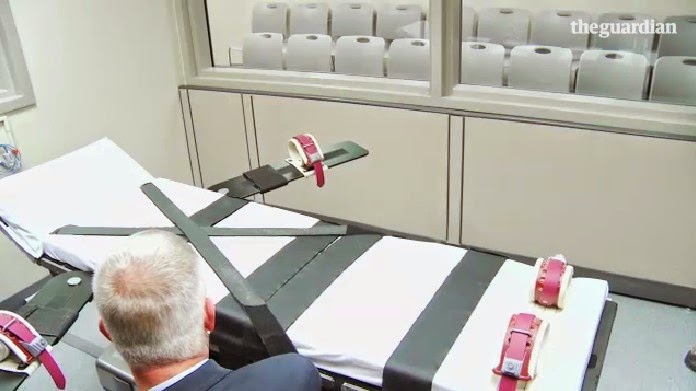
Oklahoma death chamber
For death row inmate Richard Glossip, Wednesday afternoon began as planned, preparation for his execution.

“I was in Cell L, which is the cell right next to the death chamber,” Glossip said. “I was standing there and nobody was doing anything, so I said, ‘What’s going on?’ And nobody would really tell me what was going on.”

For Glossip, the news didn’t come until a Department of Corrections worker explained his execution was stopped short just after 3 p.m. when Gov. Mary Fallin filed for a last-minute stay of execution. It was a shock, Glossip shared with KOCO just minutes later over the phone.

“I gotta say that was probably rough,” he admitted. “Probably the two roughest hours I think I’ve ever had since I’ve been locked up.”

In his phone call with KOCO, Glossip shared his stress and even addressed the Van Treese family, now left waiting for justice yet again.

“You know I really do feel like I’m a yo-yo right now,” he said. “That’s what I feel like and I think they’re (Van Treeses) probably feeling the same way I am. They’re prepared for the end of it, and I’m prepared for my end of it, and I mean you can’t call it nothing but torture for everybody.”

Now as the state reviews its execution drugs, Glossip has 37 more days to live. It's time he doesn’t plan to waste.

“I’m not going to die in 37 days, until the truth is finally in a courtroom where people can see it,” Glossip said. “I got to make sure that if I get another stay, I have to make sure that I clear my name so that way I don’t have to do this again. So I’m going to do my best to do that. It’s not easy, but I got to do my best.”

Source: koco.com, Morgan Chesky, October 1, 2015

Report an error, an omission: deathpenaltynews@gmail.com

Most viewed (Last 7 days)

South Carolina | Inmate who believes he’s died repeatedly can’t be executed, judge rules

SPARTANBURG — A 59-year-old man sentenced to death for killing a state trooper in Greenville County in 2000 can’t be executed because of a mental illness that’s left him incoherent and believing he’s immortal, a Circuit Court judge has ruled. John Richard Wood is the first condemned inmate in South Carolina found not competent to be executed since the state restarted capital punishment in September 2024. The seven executions since then include three men who chose to die by firing squad — the latest in November. Wood, convicted 24 years ago, was among death row inmates in line to receive a death warrant after exhausting their regular appeals.

China | Man sentenced to death for murder executed in Yunnan

Tian Yongming, who was initially sentenced for a series of violent crimes and then had his sentence changed to death early this year, has been executed in Yunnan province following approval from China's top court. The execution was carried out by the Intermediate People's Court in Yuxi, Yunnan, on Tuesday, with local prosecutors supervising the process. Before the execution, Tian was allowed to meet with his family members. The case dates back to September 1996, when Tian was sentenced to nine years in prison for the rape and attempted murder of his sister-in-law. After his release on July 15, 2002, he plotted revenge against the woman. On the night of Nov 13, 2002, he broke into her home armed with a knife.

Idaho eyes restart of death row executions as firing squad draws near

BOISE, Idaho — Idaho’s prison system has nearly completed execution chamber upgrades to carry out the death penalty by firing squad as the state’s lead method and will have a team of riflemen ready to go by the time a state law takes effect this summer. As part of the transition, the Idaho Department of Correction hopes to limit participation by its officers as the shooting of condemned people in prison to death is prioritized over lethal injection. Toward that effort, prisoner leadership sought to implement a push-button technology to avoid needing IDOC workers to pull the triggers.

20 Minutes to Death: Witness to the Last Execution in France

The following document is a firsthand account of the final moments of Hamida Djandoubi, a convicted murderer executed by guillotine at Marseille’s Baumettes Prison on September 10, 1977. The record—dated September 9—was written by Monique Mabelly, a judge appointed by the state to witness the proceedings. Djandoubi’s execution would ultimately be the last carried out in France before capital punishment was abolished in 1981. At the time, President Valéry Giscard d'Estaing—who had publicly voiced his "deep aversion to the death penalty" prior to his election—rejected Djandoubi’s appeal for clemency. Choosing to let "justice take its course," the President allowed the execution to proceed, just as he had in two previous cases during his term:   Christian Ranucci , executed on July 28, 1976 and Jérôme Carrein , executed on June 23, 1977. Hamida Djandoubi , a Tunisian national, was sentenced to death for killing his former lover, Elisabeth Bousquet. He was execu...

Florida executes James Ernest Hitchcock

STARKE, Fla. (AP) — A Florida man convicted of beating and choking his brother’s 13-year-old stepdaughter to death nearly 50 years ago was executed Thursday evening. James Ernest Hitchcock, 70, was pronounced dead at 6:12 p.m. following a lethal injection at Florida State Prison near Starke. He was convicted of the July 1976 killing of Cynthia Driggers. The curtain to the death chamber opened promptly at the 6 p.m. execution time. Hitchcock’s entire body was covered in a sheet up to his head. He stared at the ceiling as the team warden made a call, then gave his final statement.

US Department of Justice announces decision to resume federal executions

The Department of Justice (DOJ) announced on Friday that it will resume the federal use of capital punishment and that it is seeking death sentences against 44 defendants. DOJ also said that it will use firing squads, electrocution, or nitrogen asphyxiation if the drug used in lethal injection is unavailable. The announcement follows the Restoring and Strengthening the Federal Death Penalty report, published on April 24. The report is especially critical of the moratorium on federal executions, ordered by Attorney General Merrick Garland in July 2021, to remain until the death penalty could be conducted “fairly and humanely.” Garland was concerned about the federal lethal injection protocol, which uses only one drug, pentobarbital, and the possibility that it causes “unnecessary pain and suffering.” In response to Garland’s moratorium and concerns, President Biden commuted the sentences of 37 prisoners on federal death row, leaving only three prisoners.

Arizona | Man who murdered pastor crucifixion style requests plea deal after parents killed in plane crash

Adam Sheafe, the California man who admitted to killing a New River, Arizona, pastor in a crucifixion-style attack, has asked prosecutors to offer him a plea deal that would result in a natural life sentence rather than the death penalty he had previously sought. Advisory council attorneys representing Sheafe sent a formal plea offer to prosecutors this week, about two weeks after his father and stepmother died in a plane crash at Marana Airport on April 8, according to 12 News. Sheafe, 51, is charged with first-degree murder in the death of William Schonemann, 76, pastor of New River Bible Church, who was found dead inside his home last April.

Iran to execute first woman linked to mass protests after ‘forced confessions’

Bita Hemmati and three others have been sentenced to death for 'collusion' and 'propaganda.' Advocates claim the charges are baseless, citing a secretive process and state-televised interrogations. Iranian authorities are preparing to execute Bita Hemmati, the first woman sentenced to death in connection with the mass protests in Tehran in late December and January, according to the US-based non-profit the Human Rights Activists News Agency. Judge Iman Afshari, of Branch 26 of the Tehran Revolutionary Court, sentenced Hemmati, her husband, Mohammadreza Majidi Asl, and Behrouz Zamaninezhad, and Kourosh Zamaninezhad to death on the charge of “operational action for the hostile government of the United States and hostile groups,” in addition to discretionary imprisonment period of five years on the charge of “assembly and collusion against national security.”  

Texas | James Broadnax's appeals: US Supreme Court denies 2 claims, confession pending

Despite an 11th-hour confession from another man, James Broadnax is slated to be executed by the state of Texas later this week.  Broadnax, 37, is scheduled to be put to death by lethal injection April 30 in Huntsville. He was condemned by a Dallas County jury in 2009 for the deaths of Stephen Swan, 26, and Matthew Butler, 28, outside their Garland music studio. Broadnax and his cousin, Demarius Cummings, had set out to rob the men, but left with only $2 and a 1995 Ford, according to previous reporting from The Dallas Morning News. 

Florida executes Chadwick Scott Willacy

STARKE, Fla. -- A Florida man who set his neighbor on fire after she returned from work to find him burglarizing her home was executed Tuesday evening. Chadwick Scott Willacy, 58, received a three-drug injection and was pronounced dead at 6:15 p.m. at Florida State Prison near Starke for the 1990 killing of Marlys Sather. It was Florida's fifth execution this year. The curtain to the execution chamber went up promptly at the scheduled 6 p.m. time, and the lethal injection got underway two minutes later, after Willacy made a brief statement.