Capital punishment around the world

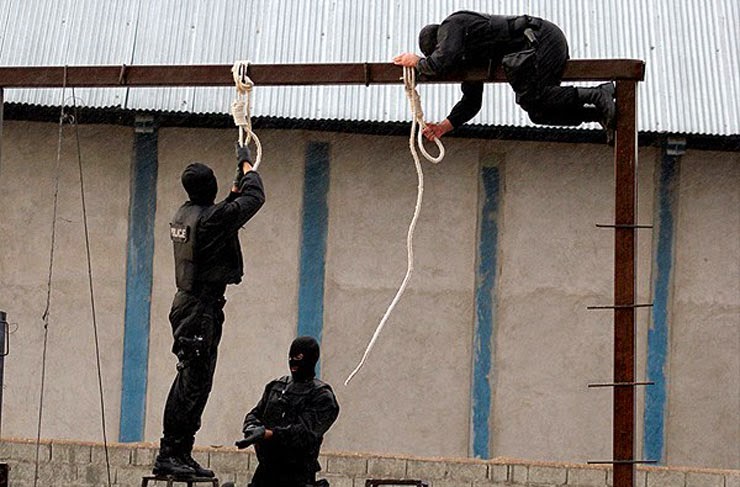
Public hanging in Iran: Medieval and barbaric punishments
While the number of executions worldwide is decreasing, some countries are continuing to execute hundreds of prisoners every year.

Executions worldwide are down almost 22 % to 607, according to a recent Amnesty International report, but that figure excludes China which maintains strict secrecy on its death penalty figures.

It is estimated more than 19,000 people are on death row worldwide.

The Australian Department of Foreign Affairs and Trade confirmed at least 17 Australians could face the death penalty for alleged crimes committed in other countries.

22 countries executed prisoners in 2014, though that's just more than 1/2 the number that executed prisoners 20 years ago.

The 5 countries with the highest rates of executions are China, Iran, Saudi Arabia, Iraq and the United States. 

#TalkAboutIt takes a closer look at the top 5 and Indonesia, where Australians Andrew Chan and Myuran Sukumaran are on death row for drug smuggling.

China

China executes more prisoners than the rest of the world combined, according to Amnesty International, which believes the number executed is around 2,466.

But the organisation said due to state secrets the true figure of executions is not known.

China executes by lethal injection or firing squad.

Drug-related crimes accounted for 8 % of executions, while economic-related crimes accounted for 15 %.

China's "strike hard" campaign to act tough on terrorism resulted in 21 executions between June and August 2014 in the autonomous region of Xinjiang, home to the large, mostly Muslim Uighur ethnic minority.

An Australian man has been sentenced to death for drug smuggling, but that could be commuted to life.

Meanwhile, Australian-New Zealand dual national Peter Gardner remains in a Chinese jail and could face a death penalty over drug smuggling allegations.

A spokesperson from New Zealand's Ministry of Foreign Affairs and Trade said consular staff from the country's Consulate-General in Guangzhou are continuing to provide consular advice and check on Mr Gardner's well-being.

Iran

More than 289 people were executed in Iran in 2014, but Amnesty International believes as many as 454 more were killed.

Public hanging is Iran's most common form of capital punishment, despite a 2008 moratorium on public executions.

Under some circumstances, those sentenced are flogged before they are hanged.

Crimes punishable by death include murder, terrorism-related offences, rape, robbery, kidnapping, burglary, drug offences such as trafficking, economic crimes, adultery, apostasy, homosexuality, treason and espionage, according to Cornell University.

Stoning is also a legal method of execution for adultery in Iran and is overwhelmingly inflicted on women.

Women are buried up to their shoulders but men only up to their waists.

Stones are hurled at them until they die or escape the pit. The condemned are spared if they free themselves before dying.

Iran has the world's highest rate of execution by stoning, though the practice is gaining popularity in Afghanistan, Iraq and Pakistan.

Iranian human rights lawyer Shadi Sadr said most stonings take place in secret, at prisons, in the desert or during early mornings in cemeteries.

Iran's Islamic Penal Code, adopted in 2013, does not prohibit stoning and permits punishment prescribed by Sharia law, which includes stoning.

The UN harshly condemns the practice.

Saudi Arabia

Saudi Arabia executed at least 90 people in 2014, including 2 women.

Beheading in public using a sword is the most common form of execution in the country.

Shooting prisoners via firing squad is also used.

Death penalty crimes include adultery, blasphemy, fornication, homosexuality and sorcery.

Stoning is also a legal method of execution for adultery in Saudi Arabia, as in Iran.

Iraq

Iraq put at least 61 prisoners to death in 2014, with hanging being the preferred method of execution.

In Iraq, prisoners can be hung for war crimes, treason, espionage, military offences, drug offences, rape, kidnapping, murder and aggravated murder.

United States

The United States executed 35 death row inmates in 2014, down from 39 in 2013, all through lethal injection.

It is the only Western democracy in the top 10 executing nations.

Capital punishment is legal in 32 states, but only 7 states put prisoners to death in 2014, with most executions conducted in the southern states including Texas, Florida and Oklahoma.

All of those executed in 2014 had been on death row for 8 years or more.

7 states have not conducted executions for a decade.

The crimes punishable by death vary from state to state, but 1st-degree murder and treason are the primary crimes.

The state of Washington has an official moratorium on executions.

Lethal injection remains the preferred method of execution across the country.

However there is currently a shortage, impacted by a ban on EU countries supplying the necessary components.

The worst year to date for botched executions by lethal injection in the United States was 2014.

Electrocution remains an option for 8 states. Tennessee uses the electric chair if the lethal drugs are not available for injection.

Gas chamber, hanging and firing squad are backup options for some states where lethal injection is not a possibility.

About 150 people have been exonerated since 1973.

Indonesia

The firing squad is the preferred method of execution in Indonesia.

In December 2014, Indonesia resumed executions for drug-related offences under the new leadership of president Joko Widodo.

Within Mr Widodo's 1st 100 days of office, 6 prisoners were executed.

If the president maintains his hardline stance on drug crimes, about 40 more foreign citizens on death row could be executed.

At the end of 2014, 64 out of 130 death row prisoners were due to be killed for drug trafficking.

A number of crimes are punishable by death including murder, terrorism, robbery, treason, economic crimes, espionage and war crimes.

Source: abc.net.au, April 6, 2015

Report an error, an omission: deathpenaltynews@gmail.com

Most viewed (Last 7 days)

China executes Frenchman convicted in 2010 for drug trafficking

Chan Thao Phoumy, a 62-year-old Frenchman born in Laos, was executed, “despite the efforts of the French authorities, including efforts to obtain a pardon on humanitarian grounds for our compatriot”, said a foreign ministry statement. Phoumy, who was born in Laos, had been sentenced to death in 2010 following a conviction for drug trafficking. Despite sustained diplomatic pressure and formal requests for clemency on humanitarian grounds, Chinese authorities proceeded with the capital sentence.  A massive drug manufacturing and distribution operation Chan Thao Phoumy was convicted for his involvement in a massive drug manufacturing and distribution operation that remains one of the largest drug-related cases in Chinese history. Phoumy and his accomplices were convicted of manufacturing approximately 8 tons of crystal methamphetamine between 1999 and 2003.

20 Minutes to Death: Witness to the Last Execution in France

The following document is a firsthand account of the final moments of Hamida Djandoubi, a convicted murderer executed by guillotine at Marseille’s Baumettes Prison on September 10, 1977. The record—dated September 9—was written by Monique Mabelly, a judge appointed by the state to witness the proceedings. Djandoubi’s execution would ultimately be the last carried out in France before capital punishment was abolished in 1981. At the time, President Valéry Giscard d'Estaing—who had publicly voiced his "deep aversion to the death penalty" prior to his election—rejected Djandoubi’s appeal for clemency. Choosing to let "justice take its course," the President allowed the execution to proceed, just as he had in two previous cases during his term:   Christian Ranucci , executed on July 28, 1976 and Jérôme Carrein , executed on June 23, 1977. Hamida Djandoubi , a Tunisian national, was sentenced to death for killing his former lover, Elisabeth Bousquet. He was execu...

Iran | 23-Year-Old Protester Ali Fahim Hanged; 10 Political Prisoners Executed in 8 Days

Iran Human Rights (IHRNGO); 6 April 2026: State media reported the execution of Ali Fahim, a 23-year-old protester arrested at the 8 January protests in Tehran. He is the fourth defendant in the case to be hanged in five days. His co-defendants Abolfazl Salehi Siavashani, Shahab Zohdi and Yaser Rajaifar are at grave and imminent risk of execution. Condemning Ali Fahim’s execution in the strongest terms, IHRNGO calls on the international community and civil society organisations to react strongly to the daily execution of political prisoners in Iran.

Indonesian grandmother freed from Malaysian death row returns home: ‘feels unreal’

Ani Anggraeni spent nearly 15 years in prison for drug trafficking before her death sentence was commuted and she was later pardoned An Indonesian woman who spent nearly 15 years on death row in a Malaysian prison for drug trafficking has returned home after receiving clemency, in a case rights groups say highlights the exploitation of poor migrant women in cross-border drug operations. Ani Anggraeni, also known as Asih, boarded a flight from Kuala Lumpur to Jakarta late on Thursday after being freed from custody.

Iran executes two more death sentences after protests

Two more death sentences have been carried out in Iran in connection with the recent mass protests. According to the Fars news agency, they are Shahin Vahedparast Kaloor (30) and Mohammedamin Biglari (19).  The judiciary accuses them of breaking into a "militarily classified site" of the paramilitary Basij militia in Tehran together with others and setting fire there. An attempted theft of weapons is said to have failed.

Former FedEx driver pleads guilty to killing 7-year-old girl after making delivery at her Texas home

FORT WORTH, Texas — Tanner Lynn Horner, a former contract delivery driver for FedEx, pleaded guilty Tuesday to the 2022 capital murder and aggravated kidnapping of 7-year-old Athena Strand, a move that abruptly shifted the proceedings into a high-stakes punishment phase where jurors will decide between life imprisonment and the death penalty. Horner, 34, entered the plea in a Tarrant County courtroom as his trial was set to begin. The case was moved to Fort Worth from neighboring Wise County last year after defense attorneys argued that pretrial publicity would prevent a fair trial in the community where the girl disappeared.

Saudi Arabia executes man convicted on terrorism-related charges

A man convicted on terrorism-related charges has been executed in Saudi Arabia following a final court ruling, according to an official statement from the Interior Ministry and reporting patterns consistent with international news agencies. The Interior Ministry said the individual, identified as Saoud bin Muhammad bin Ali al-Faraj, was convicted of multiple offenses including alleged affiliation with a foreign-linked terrorist organization, targeting security personnel, supporting and financing terrorist activities, harboring suspects, manufacturing explosives, and illegal possession of weapons.The case was initially investigated by security authorities before being referred to the judiciary.

North Carolina | Prosecutors seek death penalty for Fayetteville mom in deaths of Blake and London Deven

Nearly 2 years after a Cumberland County mother was arrested in the deaths of her adoptive children, prosecutors say they will seek the death penalty in the high-profile case.  Avantae Deven faces 5 felony charges, including child abuse and 2 counts of 1st-degree murder in the deaths of her children, Blake and London Deven. A grand jury indicted her on March 10. Her next court appearance is scheduled for May 6.  "I think it's good," said John Whitker, Deven's next-door neighbor on Berridale Drive. "She knew what she was doing. She was planning, and then she starved them. She took advantage of the lowest common denominator." 

Florida Supreme Court halts execution of police officer convicted of raping, murdering girl

STARKE, Fla. (AP) — The execution of a former Florida police officer convicted of raping and murdering an 11-year-old girl was temporarily halted Thursday by the Florida Supreme Court. The court issued a stay in execution for 68-year-old James Aren Duckett, who was scheduled to receive a three-drug injection Tuesday at Florida State Prison near Starke. Duckett was sentenced to death in 1988 after being convicted of first-degree murder and sexual battery.

Israel passes death penalty law for terrorists convicted of deadly attacks

JERUSALEM (AP) — Israel’s parliament on Monday passed a law approving the death penalty for Palestinians convicted of murdering Israelis, a measure that has been harshly condemned by the international community and rights groups as discriminatory and inhumane. The passage of the bill marked the culmination of a years-long drive by the far-right to escalate punishment for Palestinians convicted of nationalistic offenses against Israelis. Prime Minister Benjamin Netanyahu came to the Knesset to vote for the bill in person. The law makes the death penalty — by hanging — the default punishment for West Bank Palestinians convicted of nationalistic killings. It also gives Israeli courts the option of imposing the death penalty on Israeli citizens convicted on similar charges — language that legal experts say effectively confines those who can be sentenced to death to Palestinian citizens of Israel and excludes Jewish citizens.