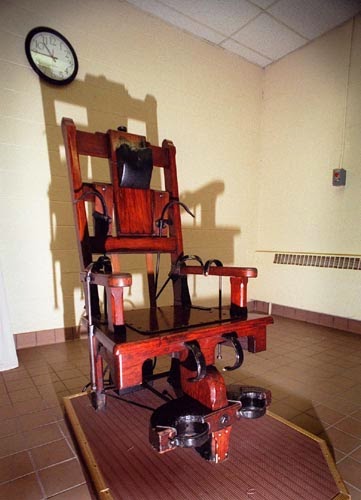
Might Ohio use electric chair again?

The electric chair at Southern Ohio Correctional Facility
Electric chair at Southern
Ohio Correctional Facility
The difficulty of obtaining drugs for executions has some Ohio legislators talking about alternatives, including the electric chair.

"There are other options," said Rep. Jim Buchy, R-Greenville, a co-sponsor of legislation to keep the supplier of execution drugs secret.

"Rope is cheap," said state Sen. Bill Seitz, R-Cincinnati.

No one is seriously suggesting - at least not yet - taking "Old Sparky," Ohio's electric chair, out of retirement, or returning to hanging, which the state abandoned in 1897.

But Ohio's problem with lethal-injection drugs is coming to a head: The scheduled Feb. 15 execution of Ronald Phillips is 90 days away.

Legislators are rushing to pass House Bill 663 before the lame-duck legislative session ends on Dec. 31 so that the Ohio Department of Rehabilitation and Correction can obtain drugs it needs at least a month before the execution. The legislation would protect the identity of the source of the drugs from disclosure to the public and news media, and allow physicians who participate in the process - as well as execution-team members - to remain anonymous.

The deadline is crucial because the state must inform U.S. District Judge Gregory Frost of any changes in the execution protocol, including use of new or different drugs, 30 days before a scheduled execution. Frost, the judge handling lethal-injection lawsuits filed by death row inmates, postponed executions this year until the drug issue is resolved.

Ohio's most-recent execution, of Dennis McGuire on Jan. 16, was troubled. After the injection of midazolam and hydromorphone into his veins, McGuire struggled against the restraints around his body for about 20 minutes. He repeatedly gasped for air, made snorting and choking sounds and clenched his hands into fists.

That combination of drugs had never been used in the U.S., and, if Ohio prisons director Gary Mohr has his way, will never be used again in Ohio. The state had resorted to the untested combination when pentobarbital, the single drug used previously, became unavailable because manufacturers no longer sold it for use in executions.

The drug still can't be obtained except from small "compounding pharmacies" that mix drugs to customer specifications.

Ohio House Speaker William Batchelder, R-Medina, said the issue can't wait, "or we're going to have people pass away prior to execution."

If Ohio were to revert to the electric chair, it would not be the 1st state to do so. Tennessee passed a law this year requiring electrocution if lethal-injection drugs aren't available. Tennessee also enacted a law last year shielding the source of execution drugs from public disclosure.

The Death Penalty Information Center, a nonpartisan capital-punishment clearinghouse, says 8 states allow electrocutions, but most of them don't use it.

In addition, Arizona, Missouri and Wyoming allow the gas chamber, Delaware, New Hampshire and Washington permit hanging, while Oklahoma and Utah allow the firing squad under limited circumstances.

Even if Ohio would, like Tennessee, go back to electrocutions, there's a problem: Old Sparky was unplugged and shipped in 2002 to what is now the Ohio History Connection. It was the focal point of a 2011 exhibition, "Controversy: Pieces You Don't Normally See," that attracted thousands of visitors to the museum at 17th Street and I-71. The wood, metal and leather chair was used to execute 312 men and 3 women between 1897 and 1963.

It is now in storage.

Lethal injection, by law, became the only means of execution in Ohio in 2001. However, that doesn't rule out other execution methods being added. There have been discussions of options, including a gas administered by a mask fitted over the face.

Richard Dieter, executive director of the Death Penalty Information Center, said Missouri, Georgia and Texas have, like Tennessee, passed laws or have by administrative rule cloaked the source of lethal-injection drugs. Georgia made it a crime to reveal the drugs or their source.

Dieter said he's uncomfortable with a system that hides vital information from the public about government's ultimate power of life and death.

"This is a curious path to go down. States would be better off being more upfront about this.

"The fundamental principle is about how government is kept in check by the people knowing what government is doing. ... It makes a difference where the drugs come from, just as it would make a difference where the bolts come from in bridges that the state builds."

Dieter said he is unaware of pharmacies or drug suppliers being harassed or threatened, something suggested in the Ohio proposal as the rationale for confidentiality. But there have been issues. A Houston pharmacy stopped selling execution drugs when it was publicly revealed as a supplier. A Missouri pharmacy that sold drugs to Oklahoma was sued for allegedly violating a prohibition against interstate sale of drugs.

The American Civil Liberties Union of Ohio slammed the legislation. "It's not only a bad idea, it is bad governance to ram through during a postelection session without due and serious consideration," said Mike Brickner, ACLU senior policy analyst.

The Ohio Newspaper Association is opposed to making secret the records of execution drugs. In a column, association Executive Director Dennis Hetzel said he was "shocked by the sweeping language and the overall tone" of the legislation.

"Under the current language, it will be impossible for journalists, citizens, families and anyone else outside a handful of government officials and bureaucrats to scrutinize the process. The new, open-ended exception will invite the courts to block access to more and more information."

Source: Columbus Dispatch, November 17, 2014

Most viewed (Last 7 days)

Tennessee executes Harold Wayne Nichols

Thirty-seven years after confessing to a series of rapes and the murder of Karen Pulley, Nichols expressed remorse in final words Strapped to a gurney in the execution chamber at Riverbend Maximum Security Institution Thursday morning, Harold Wayne Nichols made a final statement.  “To the people I’ve harmed, I’m sorry,” he said, according to prison officials and media witnesses. “To my family, know that I love you. I know where I’m going to. I’m ready to go home.”

USA | Should Medical Research Regulations and Informed Consent Principles Apply to States’ Use of Experimental Execution Methods?

New drugs and med­ical treat­ments under­go rig­or­ous test­ing to ensure they are safe and effec­tive for pub­lic use. Under fed­er­al and state reg­u­la­tions, this test­ing typ­i­cal­ly involves clin­i­cal tri­als with human sub­jects, who face sig­nif­i­cant health and safe­ty risks as the first peo­ple exposed to exper­i­men­tal treat­ments. That is why the law requires them to be ful­ly informed of the poten­tial effects and give their vol­un­tary con­sent to par­tic­i­pate in trials. Yet these reg­u­la­tions have not been fol­lowed when states seek to use nov­el and untest­ed exe­cu­tion meth­ods — sub­ject­ing pris­on­ers to poten­tial­ly tor­tur­ous and uncon­sti­tu­tion­al­ly painful deaths. Some experts and advo­cates argue that states must be bound by the eth­i­cal and human rights prin­ci­ples of bio­med­ical research before using these meth­ods on prisoners.

Georgia parole board suspends scheduled execution of Cobb County death row prisoner

The execution of a Georgia man scheduled for Wednesday has been suspended as the State Board of Pardons and Paroles considers a clemency application.  Stacey Humphreys, 52, would have been the state's first execution in 2025. As of December 16, 2025, Georgia has carried out zero executions in 2025. The state last executed an inmate in January 2020, followed by a pause due to COVID-19. Executions resumed in 2024, but none have occurred this year until now. Humphreys had been sentenced to death for the 2003 killings of 33-year-old Cyndi Williams and 21-year-old Lori Brown, who were fatally shot at the real estate office where they worked.

Oklahoma board recommends clemency for inmate set to be executed next week

A voting board in Oklahoma decided Wednesday to recommend clemency for Tremane Wood, a death row inmate who is scheduled to receive a lethal injection next week at the state penitentiary in McAlester.  Wood, 46, faces execution for his conviction in the 2001 murder of Ronnie Wipf, a migrant farmworker, at an Oklahoma City hotel on New Year's Eve, court records show. The recommendation was decided in a 3-2 vote by the Oklahoma Pardon and Parole Board, consisting of five members appointed by either the governor or the state's top judicial official, according to CBS News affiliate KWTV. Oklahoma Gov. Kevin Sitt will consider the recommendation as he weighs whether to grant or deny Wood's clemency request, which would mean sparing him from execution and reducing his sentence to life in prison without the possibility of parole.

China | Former Chinese senior banker Bai Tianhui executed for taking US$155 million in bribes

Bai is the second senior figure from Huarong to be put to death for corruption following the execution of Lai Xiaomin in 2021 China has executed a former senior banker who was found guilty of taking more than 1.1 billion yuan (US$155 million) in bribes. Bai Tianhui, the former general manager of the asset management firm China Huarong International Holdings, was executed on Tuesday after the Supreme People’s Court approved the sentence, state broadcaster CCTV reported.

Iran | Child Bride Saved from the Gallows After Blood Money Raised Through Donations, Charities

Iran Human Rights (IHRNGO); December 9, 2025: Goli Kouhkan, a 25-year-old undocumented Baluch child bride who was scheduled to be executed within weeks, has been saved from the gallows after the diya (blood money) was raised in time. According to the judiciary’s Mizan News Agency , the plaintiffs in the case of Goli Kouhkan, have agreed to forgo their right to execution as retribution. In a video, the victim’s parents are seen signing the relevant documents. Goli’s lawyer, Parand Gharahdaghi, confirmed in a social media post that the original 10 billion (approx. 100,000 euros) toman diya was reduced to 8 billion tomans (approx. 80,000 euros) and had been raised through donations and charities.

Afghanistan's Taliban rulers carry out public execution in sports stadium

The man had been convicted of killing 13 members of a family, including children, and was executed by one of their relatives, according to police. Afghanistan's Taliban authorities carried out the public execution of a man on Tuesday convicted of killing 13 members of a family, including several children, earlier this year. Tens of thousands of people attended the execution at a sports stadium in the eastern city of Khost, which the Supreme Court said was the eleventh since the Taliban seized power in 2021 in the wake of the chaotic withdrawal of US and NATO forces.

Burkina Faso to bring back death penalty

Burkina Faso's military rulers will bring back the death penalty, which was abolished in 2018, the country's Council of Ministers announced on Thursday. "This draft penal code reinstates the death penalty for a number of offences, including high treason, acts of terrorism, acts of espionage, among others," stated the information service of the Burkinabe government. Burkina Faso last carried out an execution in 1988.

Who Gets Hanged in Singapore?

Singapore’s death penalty has been in the news again.  Enshrined in law in 1975, a decade after the island split from Malaysia and became an independent state, the penalty can see people sentenced to hang for drug trafficking, murder or firearms offenses, among other crimes. Executions have often involved trafficking under the Misuse of Drugs Act, with offenses measured in grams.  Those executed have included people from low-income backgrounds and foreign nationals who are sometimes not fluent in English, according to human rights advocates such as Amnesty International and the International Drug Policy Consortium. 

Afghanistan | Two Sons Of Executed Man Also Face Death Penalty, Says Taliban

The Taliban governor’s spokesperson in Khost said on Tuesday that two sons of a man executed earlier that day have also been sentenced to death. Their executions, he said, have been postponed because the heir of the victims is not currently in Afghanistan. Mostaghfer Gurbaz, spokesperson for the Taliban governor in Khost, also released details of the charges against the man executed on Tuesday, identified as Mangal. He said Mangal was accused of killing members of a family.