Japan: Public release of death penalty paperwork answers some questions on process

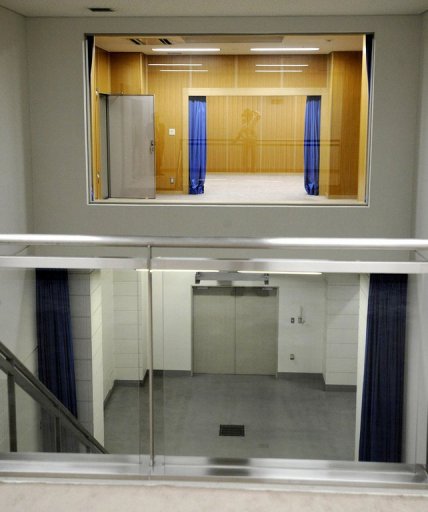
Main Gallows
at Tokyo's Detention Center
The administrative procedures that take place between a death sentence and execution in Japan have been revealed through a freedom-of-information request filed by the Mainichi.

The Ministry of Justice handed the Mainichi 282 pages of documents relating to the execution of 12 inmates since 2009, marking the first time that the steps surrounding an execution have been made public. However, 147 of the pages -- more than 1/2 -- were completely blacked out.

The signing of an execution order by the justice minister is a concept that the public has come to understand as protocol through media reports, but according to the newly disclosed information, the justice minister does not sign execution orders. Rather, he or she signs another type of document titled "assessment results of the execution case."

The actual execution order bears the name of the justice minister, with the minister's official seal affixed next to it. However, it is not the job of the justice minister to affix the seal.

"Generally, someone affixes the minister's official seal at the orders of the head of the administrative division," a ministry official said.

There are 2 execution approval routes that must be taken after an inmate is sentenced to death, that involve a total 13 people. One, called the "criminal route," consists of obtaining the signatures of the justice minister and vice justice minister on the aforementioned "assessment results of the execution case," as well as the seals of 5 justice ministry bureaucrats.

The other is the "correction and rehabilitation route," which requires the seals of 6 officials -- including that of a senior official at the ministry's Correction Bureau that oversees the detention center in which the inmate is held, and an official at the ministry's Rehabilitation Bureau that handles requests for pardons -- on a document that effectively serves as the execution proposal.

The Mainichi found that in the case of every execution, the documents covering the execution proposal, assessment, approval, and order were dated on the same day, with the execution itself taking place 2 to 4 days later.

The most recently disclosed documents involve 7 former death-row inmates from 2009, 2 from 2010, and 3 from 2012. The Mainichi lodged a request in early April this year for access to the papers including the execution proposals, orders and instructions pertaining to the 3 people who had been executed the previous month, in addition to paperwork surrounding the executions that took place between 2009 and 2011. The decision was made to grant access to the information by early May.

Because no executions took place in 2011 -- for the 1st time in 19 years -- there is no information from that year. The total number of pages released came to 282, with full disclosure on 58 pages, and partial disclosure on 77. Meanwhile, 147 pages had been completely blacked out.

Previous attempts have been made to shed light on the procedures following a death sentence. In 2005, a Tokyo lawyer, among others, filed a lawsuit against the justice ministry after their requests for access to paperwork for executions in 2003 and prior resulted in mostly blacked-out documents; the courts ruled against the plaintiffs in 2009. That same year, the operator of a website published online an execution order from 2008 said to have been released by the ministry.

Source: The Mainichi, June 1, 2012


Experts seek transparency in decisions to enforce death penalty

Execution chamber
at Tokyo's Detention Center
Details about how Japan's death penalty is carried out have been kept confidential for many years. Death penalty drafts and execution orders recently released by the Justice Ministry in response to a freedom-of-information request from the Mainichi are stamped "secret."

Takeshi Tsuchimoto, a former prosecutor and now a professor emeritus of criminal law at the University of Tsukuba, hailed the Justice Ministry for disclosing nine kinds of documents on death penalties meted out to 12 people since 2009, saying the ministry understood the broad scope of administrative documents subject to public disclosure and responded to the public's right to know.

But he says making public the names of ministry officials involved in approving executions could have consequences. He also says there is also room for debate on the extent to which ministry should disclose information in response to requests without public purpose.

A senior Justice Ministry official said the scope of information disclosure noticeably broadened after then Justice Minister Kunio Hatoyama started releasing the names of death-row inmates to be executed.

Hatoyama, who ordered 13 death-row inmates to be hanged during a roughly yearlong tenure as justice minister, recalled that he signed death penalty documents after carefully reading records on the 13 people and being convinced that justice could not be fulfilled unless the perpetrators of such heinous crimes were executed.

Hatoyama also said he released the names of the death-row inmates because "I felt it was necessary for the Japanese public to recognize that justice prevailed." He added that it was an afterthought that institutional information disclosure has further progressed since his time as justice minister.

But Seiken Sugiura, who did not issue any execution orders during about 11 months in office as justice minister between 2005 and 2006, says the current state of information disclosure concerning the death penalty is too closed. In order for Japan to hold full-scale debate on capital punishment, he says, the nation should emulate some states in the United States, where crime victims and media personnel can watch executions, thereby achieving greater transparency.

Lawyer Kei Shinya, who in 2004 sought information disclosure in a trial over death penalty documents prior to 2003 but was unsuccessful, points to the reality that lay judges are now required to make judgments on the pros and cons of the death penalty.

"It is the state's responsibility to fully provide data such as execution procedures to people whom the state entrusts to make grave decisions," he says, adding that the central government should further disclose information to help the public judge if death by hanging does not really constitute a "cruel" punishment as forbidden by Article 36 of the postwar Japanese Constitution.

Hidemichi Morosawa, a professor of criminology at Tokiwa University, says many victims wonder why the death sentence is not meted out to death-row inmates even six months after a death sentence is finalized, as stipulated by the Code of Criminal Procedure. He says there should be documents to explain why the death penalty is not carried out after six months and the government should explain the reasons to victims.

Source: The Mainichi, June 1, 2012

Most viewed (Last 7 days)

US | Army lays groundwork for death row executions if Trump gives approval

The Army is preparing to carry out the executions of the military's four death-row inmates if ordered to do so by the president, according to an internal planning document reviewed by ABC News. If carried out, it would mark the first time the military executed convicted American inmates in more than a half-century The plan, dubbed "Operation Resolute Justice" and issued internally in February, directs Army officials to coordinate with the Federal Bureau of Prisons to transfer condemned prisoners from the U.S. Disciplinary Barracks at Fort Leavenworth, Kansas, to the federal execution facility in Terre Haute, Indiana, where the Justice Department carried out a series of non-military federal executions during President Donald Trump's first term.

Alabama Plans to Execute Jeffrey Lee Despite Jury Vote for Life

Alabama Gov. Kay Ivey has scheduled the execution of Jeffrey Lee by nitrogen suffocation for June 11, 2026, even though his capital jury voted 7-5 against the death penalty and chose a sentence of life imprisonment without parole. The trial judge overrode the jury’s verdict and sentenced Mr. Lee to death in 2000, relying on a unique Alabama practice that allowed judges to overrule jury verdicts in death penalty cases. Alabama is the only state where judges overrode jury verdicts of life to impose the death penalty routinely—in more than 100 cases since 1976. As a result, nearly 20% of the people currently on Alabama’s death row were sentenced to death by elected judges even after their juries chose life imprisonment without parole.

Oklahoma | Richard Glossip on Life After Decades on Death Row

In an exclusive interview at home in Oklahoma City, Glossip describes his first days of freedom in a world he hasn’t experienced for nearly 30 years. For three decades, Richard Glossip lived on concrete. First at the Oklahoma County jail, after his arrest for murder in 1997, and then in the underground bunker housing death row inmates at the Oklahoma State Penitentiary. As with the rest of his surroundings, he eventually got used to the hard, unforgiving floors, although recently he’d developed painful swelling in his legs.

20 Minutes to Death: Witness to the Last Execution in France

The following document is a firsthand account of the final moments of Hamida Djandoubi, a convicted murderer executed by guillotine at Marseille’s Baumettes Prison on September 10, 1977. The record—dated September 9—was written by Monique Mabelly, a judge appointed by the state to witness the proceedings. Djandoubi’s execution would ultimately be the last carried out in France before capital punishment was abolished in 1981. At the time, President Valéry Giscard d'Estaing—who had publicly voiced his "deep aversion to the death penalty" prior to his election—rejected Djandoubi’s appeal for clemency. Choosing to let "justice take its course," the President allowed the execution to proceed, just as he had in two previous cases during his term:   Christian Ranucci , executed on July 28, 1976 and Jérôme Carrein , executed on June 23, 1977. Hamida Djandoubi , a Tunisian national, was sentenced to death for killing his former lover, Elisabeth Bousquet. He was execu...

Texas | Tanner Horner now incarcerated at the Polunsky Unit

Convicted child killer Tanner Horner has now taken up residence in one of the most brutal death row prisons after being sentenced to die by a Texas jury last month. Horner is incarcerated at the Polunsky Unit, an infamously restrictive prison outside Houston where the state's death row inmates are housed in an all-solitary confinement wing and spend at least 22 hours a day in their 60-square-foot cells. The former FedEx deliveryman, 34, was booked at the notorious prison on May 5 within hours of being sentenced for the gruesome murder of Athena Strand, 7, whom he admitted strangling while delivering a Christmas gift to her home in November 2022.

New Mississippi billboard warns criminals: ‘Firing squad is legal’

DESOTO COUNTY, Miss. (WREG) — A billboard standing on Interstate 55 southbound as you cross the Tennessee state line and enter Mississippi from Memphis is sending a grim message to those coming into the state. DeSoto County District Attorney Matthew Barton recently announced the new billboard campaign, which features the sign reading, “WELCOME TO MISSISSIPPI. WHERE THE FIRING SQUAD IS LEGAL. THINK TWICE.” It references Mississippi’s law permitting execution by firing squad under certain circumstances for inmates sentenced to death. Barton says this campaign is aimed at deterring violent crime and sends a direct message to criminals entering Mississippi.

Florida executes Andrew Richard Lukehart

Jacksonville man who killed his girlfriend’s 5-month-old baby in 1996 executed 30 years later A Jacksonville man who confessed to killing his girlfriend’s 5-month-old daughter and throwing her body in a pond 3 decades ago was executed on Tuesday evening.  Andrew Richard Lukehart, 53, was scheduled to receive a 3-drug injection starting at 6 p.m. at Florida State Prison near Starke.  He was sentenced to death after being convicted of aggravated child abuse and felony murder in the death of Gabrielle Hanshaw. The baby’s mother told News4JAX she plans to attend the execution.

Texas | Death Row Inmate Gets Resentenced to Life

Harris County district judge recommends compassionate release for Clarence Jordan A 1977 convenience store robbery that resulted in a clerk’s death landed Clarence Jordan on Texas Death Row, where he remained for decades even though he was declared incompetent for execution. On Monday, a judge recommended that the disabled man be released.  Harris County District Court Judge Katherine Thomas resentenced Jordan to life with the possibility of parole and suggested that he be considered for the Texas Department of Criminal Justice’s Medically Recommended Intensive Supervision program, also known as compassionate release.

Alabama | Judge bars nitrogen gas execution, says method is unconstitutionally cruel

MONTGOMERY, Ala. -- A federal judge on Tuesday permanently blocked Alabama from executing an inmate with nitrogen gas after declaring it violates the ban on cruel and unusual punishment. U.S. District Judge Emily Marks issued the ruling hours after an appeals court reversed her initial finding that the method was constitutional. Marks permanently enjoined the state from executing Jeffrey Lee, 49, by nitrogen gas. He was scheduled to be executed Thursday. The decision, for now, blocks the use of the controversial new execution method that the state has championed since 2024, but the issue will likely end up before the U.S. Supreme Court.

Florida | 2-time Jacksonville baby abuser is set for execution

Thirty years ago while on probation for fracturing an infant’s skull, Andrew Lukehart inflicted at least five blows to the head of another baby, then concocted a story that she was abducted before eventually leading authorities to her body in a swamp area.  At 6 p.m. Tuesday, June 2, the 53-year-old from Jacksonville is set to become Florida’s eighth man on death row to be executed in 2026. He will become the 36th under Gov. Ron DeSantis after a record 19 inmates were executed by the state in 2025, including another from Duval County: Michael Bell.