Lundbeck, the sole producer of lethal injection drug, announces it is blocking supply to US execution chambers

The producer of a key anaesthetic used in the lethal injection process has announced that it is putting in place robust and unprecedented measures to block its use in executions.
Denmark-headquartered pharmaceutical company Lundbeck is taking dramatic steps to stop its product pentobarbital (also known as Nembutal) reaching death rows across the USA. Through a combination of specialty pharmacy, drop-ship distribution and contract agreements with their buyers, Lundbeck will effectively control who has a right to purchase the drug. According to a Lundbeck press release:
“Under the program, Lundbeck will review all Nembutal orders before providing clearance for shipping the product and deny orders from prisons located in states currently active in carrying out death penalty sentences. Prior to receiving Nembutal, the purchaser must sign a form stating that the purchase of Nembutal is for its own use and that it will not redistribute any purchased product without express written authorization from Lundbeck.”
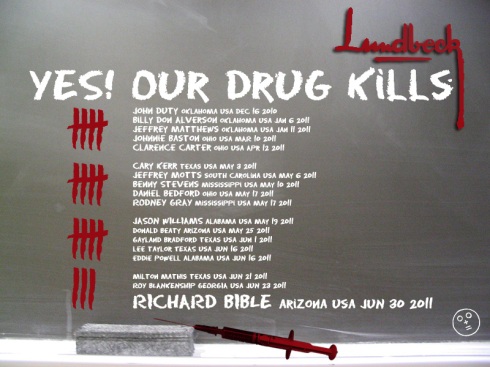
Lundbeck’s action comes in response to the growing number of US states which were starting to use pentobarbital in lethal injections, following domestic shortages of the previously-used anaesthetic sodium thiopental. To date, eight states have so far carried out a total of 18 executions using the new drug, of which Lundbeck is the sole producer in the US.
Legal action charity Reprieve is now calling on other pharmaceutical companies to put in place similar safeguards, and for the EU to act collectively to block exports to the US of all execution drugs. The desperation of the US Government became clear last month, when German Trade Minister Philipp Rösler was asked by his US counterpart Gary Locke to ‘help out’ with supplies of sodium thiopental (a request which was denied).
Reprieve investigator Maya Foa said: “This is a welcome step by Lundbeck, which shows that it is possible to take action to stop the supply of drugs for use in executions.
“Other pharmaceutical companies should now follow Lundbeck’s example; Lundbeck has proven that manufacturers can control the use and distribution of their drugs: any company manufacturing execution drugs who refuses to take such steps will be directly complicit in executions.
“We also need to see action from the European Commission to block the export of execution drugs from the EU to the US. Several European firms have already become involved in this grim business on their watch – this must not be allowed to happen again.”
1. For further information please contact Donald Campbell or Katherine O'Shea in Reprieve’s press office on +44 (0)20 7427 1082
2. Lundbeck’s press release, detailing the steps which they are taking, can be found here.
3. The eight states which have so far carried out executions using pentobarbital, and the names of the people executed, are as follows:
Alabama: Jason Williams, Eddie Powell
Georgia: Roy Willard Blankenship
Mississippi: Benny Stevens, Rodney Gray
Oklahoma: John David Duty, Billy Don Alverson, Jeffrey Matthews
Ohio: Johnnie Baston, Clarence Carter, Daniel Bedford
South Carolina: Jeffrey Motts
Texas: Cary Kerr, Gayland Bradford, Lee Andrew Taylor, Milton Mathis
Arizona: Donald Beaty, Richard Bible
Lundbeck and pentobarbital: pharma takes a stand
The announcement by Danish pharmaceutical firm Lundbeck on Friday that it is restricting the distribution of pentobarbital represents a landmark decision. This is the first time that a major global pharmaceutical company has taken such direct action to tighten up its supply chain to ensure that its drugs are used to benefit the health of patients, not assist in state-sponsored execution. It follows months of pressure from human rights advocates. At the end of last year, US death row states found it difficult to get access to the previous drug, thiopental, for executions following an export ban from the UK.
Lethal injection is perceived as a more medical, and hence humane, method than hanging, stoning, shooting or electrocution. Yet the medicalisation of executions is an abomination of medical ethics, banned by all medical professional bodies, including the American Medical Association. Doctors' prime purpose is to help patients: "first do no harm" should be a doctor's credo, not assist in state-sponsored killing. Previously, the attention of human rights campaigners has been directed at the physicians and healthcare staff who have assisted in executions. Lundbeck's remarkable decision has, in effect, set an industry standard that no drug company should allow their products to be used for executions, even if without their authority.
To date, 17 people have been executed using the novel, and hence untested, pentobarbital regime. The most recent to die, Roy Blakenship, was executed last week [Arizona's Richard Lynn Bible was executed on June 30, 2011 using pentobarbital supplied by Lundbeck]. Witnesses reported that he "appeared to grimace" and that he "jerked his head several times throughout the procedure and muttered after the pentobarbital was injected into his veins before he died". One medical expert, Dr David Waisel, has testified that "I can say with certainty that Mr [Roy] Blankenship was inadequately anesthetised and was conscious for approximately the first three minutes of the execution and that he suffered greatly."
Few doctors involved in executions have been prepared to go public. One who has, Dr Carlo Musso, was directly involved in Blakenship's execution. Dr Musso stated his opposition to the death penalty in a 2006 interview. Then, Dr Musso perceived his role as a palliative care physician on death row. "It just seems wrong for us to walk away, to abdicate our responsibility to the patients," he said at the time.
This year has seen a gear-change in the fight against lethal injection. The ban on imports into the US of the previous agent, thiopental, led to a strain on the death row supply chain. Dr Musso himself has recently been reported for allegedly illegally importing thiopental for executions. As a consequence of the thiopental shortage, US executioners have, for the first time, switched to using pentobarbital – a drug licensed for the treatment of the most refractory forms of epilepsy, not killing. Last month, I and over 60 other doctors published an open letter to pentobarbital's Danish manufacturer, Lundbeck, in the Lancet to "stop issuing platitudes" and tighten up their supply chain to prevent the abuse of pentobarbital for executions.
Lundbeck's CEO had stated that he "strongly opposes the use of pentobarbital for executions" and has written to all the death penalty states stipulating its opposition. When the states involved ignored Lundbeck's position and continued with botched executions, Lundbeck took today's action, which will "deny distribution of pentobarbital to prisons in US states currently carrying out the death penalty by lethal injection". There is, in fact, no legitimate use of this drug in a prison: if a patient is so ill that they need pentobarbital, they should be in a critical care unit with intensive monitoring, not languishing on death row. Finally, Lundbeck realised that the pharmaceutical industry, like doctors, should be about producing high-quality therapeutics to improve patient's health, not kill people.
Today, there is a real opportunity to see the end of the death penalty in the US – if other manufacturers follow suit. Put bluntly, if another drug company ends up supplying death row, I and the more than 100 healthcare workers who have petitioned Lundbeck to date will be after them. The only way to see the end of the death penalty, as Dr Musso and Lundbeck have previously stated as their wish, is not involve oneself – whether physician or pharma. What threatened to be a PR disaster for Lundbeck, the firm has, by its action, turned into a human rights victory.
Source: The Guardian, July 1, 2011
Related articles:
Jun 15, 2011
"The death toll is increasing at an alarming rate for Lundbeck; the sooner they put in place controls on the distribution of the drug, the better. Rigorous and committed action on the part of the Danish pharmaceutical ...
Jun 17, 2011
Doctors who've prescribed medicines produced by H. Lundbeck A/S urged the Danish drugmaker to make more of an effort to stop the use of one of its treatments in executing U.S. prisoners facing the death penalty. ...
Jun 14, 2011
This letter, signed by 63 medical professionals, outlines a number of strong arguments to demonstrate, if need be, that Lundbeck is not actually doing anything to stop the distribution of pentobarbital to U.S. ...
Jun 21, 2011
Reprieve spokesperson Donald Campbell said: “This appalling case shows just how urgent the need is for Lundbeck to restrict the flow of their drugs to US death chambers. Lundbeck's announcement of plans to act is ...
Use the tags below or the search engine at the top of this page to find updates, older or related articles on this Website.
Comments
Post a Comment
Pro-DP comments will not be published.