Oklahoma botches Clayton Lockett execution; inmate dies of massive heart attack 30 minutes after lethal injection fails
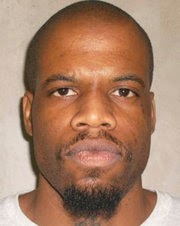 |
| Clayton Lockett |
At 6:37 Clayton Lockett was not unconscious and said "something is wrong".
Clayton Lockett convulsed several times, his chest and head rising off the gurney at multiple points. Inmate 'struggled violently, groaned and writhed', witnesses said.
Oklahoma Dept. of Corrections closed the blinds on Clayton Lockett at 6:39 after inmate started moving and talking.
Clayton Lockett's execution was suspended. His status is unknown right now.
Execution of Clayton Lockett failed. Execution of Charles Warner stayed by Corrections director Robert Patton.
BREAKING
Clayton Lockett died inside the execution chamber at 7:06 pm of a massive heart attack according to DOC officials.
Oklahoma halts execution after botching delivery of new drug combination, postpones 2nd execution slated for tonight.
Source: Agencies, Twitter feed, April 29, 2014
Related article:
- Oklahoma is Set to Execute 2 Men Using a Secretive, Untested Drug Cocktail, Mother Jones, Associated Press, The Guardian, April 29, 2014
Oklahoma postpones second execution after first is botched
Execution of Clayton Lockett halted after 20 minutes as state uses untested drug cocktail, but inmate dies soon afterwards
The execution of convicted murderer Clayton Lockett was halted nearly 20 minutes after it began, but he later died of a heart attack inside the execution chamber at the Oklahoma state penitentiary. For three minutes after the first drugs were delivered, he struggled violently, groaned and writhed, lifting his shoulders and head from the gurney before the blinds to the room were lowered 16 minutes after the execution began.
Click here to read the full article
Source: The Guardian, April 30, 2014 (local time)
Oklahoma postpones second execution after first is botched
Execution of Clayton Lockett halted after 20 minutes as state uses untested drug cocktail, but inmate dies soon afterwards
The execution of convicted murderer Clayton Lockett was halted nearly 20 minutes after it began, but he later died of a heart attack inside the execution chamber at the Oklahoma state penitentiary. For three minutes after the first drugs were delivered, he struggled violently, groaned and writhed, lifting his shoulders and head from the gurney before the blinds to the room were lowered 16 minutes after the execution began.
Click here to read the full article
Source: The Guardian, April 30, 2014 (local time)
Oklahoma Postpones Execution After First Is Botched
 |
| Oklahoma Death Chamber |
McALESTER, Okla. — What was supposed to be the first of two executions here Tuesday night was halted when the prisoner, Clayton D. Lockett, began to twitch and gasp after he had already been declared unconscious and called out “man” and “something’s wrong,” according to witnesses.
The administering doctor intervened and discovered that “the line had blown,” said the director of corrections, Robert Patton, meaning that drugs were no longer flowing into his vein.
At 7:06 p.m., Mr. Patton said, Mr. Lockett died of a heart attack.
Mr. Patton said he had requested a stay of 14 days in the second execution scheduled for Tuesday night, of Charles F. Warner.
It was a chaotic and disastrous step in Oklahoma’s long effort to execute the two men, overcoming their objections that the state would not disclose the source of the drugs being used in a newly tried combination.
It did not appear that any of the drugs themselves failed, but rather the method of administration, but it resulted in what witnesses called an agonizing scene.
“This was botched, and it was difficult to watch,” said David Autry, one of Mr. Lockett’s lawyers.
A doctor started to administer the first drug, a sedative intended to knock the man out, at 6:23. Ten minutes later, the doctor said that Mr. Lockett was unconscious, and started to administer the next two drugs, a paralytic and one intended to make the heart stop.
At that point, witnesses said, things began to go awry. Mr. Lockett’s body moved, his foot shook, and he mumbled, witnesses said.
At 6:37, he tried to rise and exhaled loudly. At that point, prison officials pulled a curtain in front of the witnesses and the doctor discovered a “vein failure,” Mr. Patton said.
Source: The New York Times, April 29, 2014
Oklahoma execution: Clayton Lockett writhes on gurney in botched procedure

The state of Oklahoma botched one execution and was forced to call off another on Tuesday when a disputed cocktail of drugs failed to kill a condemned prisoner who was left writhing on the gurney.
After the failure of a 20-minute attempt to execute him, Clayton Lockett was left to die of a heart attack in the execution chamber at the Oklahoma state penitentiary in McAlester. A lawyer said Lockett had effectively been "tortured to death".
For three minutes after the first drugs were delivered Lockett struggled violently, groaned and writhed, lifting his shoulders and head from the gurney.
Some 16 minutes after the execution began, and without Lockett being declared dead, the blinds separating the chamber from the viewing room were closed. The process was called off shortly afterwards. Lockett died 43 minutes after the first executions drugs were administered.
The execution of Charles Warner, scheduled for 8pm local time, was then postponed. Both were due to have been carried out with a drug cocktail using dosages never before tried in American executions.
Oklahoma decided to lethally inject Lockett and Warner with midazolam, a powerful sedative and anti-seizure drug that also induces amnesia, followed by vecuronium bromide and potassium chloride. Florida has used a similar method but it employed a dose of midazolam five times greater. Ohio used midazolam alongside a different drug, hydromorphone, in the January execution of Dennis McGuire, which took more than 20 minutes.
The grim outcome on Tuesday in Oklahoma appeared likely to fuel the debate over the death penalty in the US, in particular the use of these untested drugs combinations.
Click here to read the full article
Source: The Guardian, April 30, 2014
How Oklahoma's Botched Execution Affects the Death-Penalty Debate
Officials in Oklahoma had many reasons to suspect there would be problems with the execution of death-row inmate Clayton Lockett last night. They were using an untested mix of lethal drugs, never previously used in that dosage combination, obtained through secret means, which precluded the possibility of oversight from attorneys or medical officials on the quality of the drugs. They were warned by medical experts, and asked by defense attorneys, to open up the process to review—by the courts, by doctors, by some members of the public. Yet they refused.
So the execution of Clayton Lockett proceeded. What happened was anything but standard: The man's heart essentially exploded after officials stopped pumping his body full of the deadly chemicals. "We always argue that something like this is going to happen," one defense attorney close to the case told me Tuesday night, "but we always hope it won't." This time, it did.
KFOR in Oklahoma provided a timeline:
6:23 PM – Prison officials raise the blinds. Execution begins.
6:28 PM – Inmate shivering, sheet shaking. Breathing deep.
6:29 PM – Inmate blinking and gritting his teeth. Adjusts his head.
6:30 PM – Prison officials check to see if inmate is unconscious. Doctor says, “He’s not unconscious." Inmate says “I’m not.” Female prison official says, “Mr. Lockett is not unconscious.”
6:32 PM – Inmate’s breathing is normal, mouth open, eyes shut. For a second time, prison officials check to see if inmate is unconscious.
6:33 PM – Doctor says, “He is unconscious.” Prison official says “Mr. Lockett is unconscious.”
6:34 PM – Inmate’s mouth twitches. No sign of breathing.
6:35 PM – Mouth movement.
6:36 PM – Inmate’s head moves from side to side, then lifts his head off the bed.
6:37 PM – Inmate lifts his head and feet slightly off the bed. Inmate tries to say something, mumbles while moving body.
6:38 pm – More movement by the inmate. At this point the inmate is breathing heavily and appears to be struggling.
6:39 PM – Inmate tries to talk. Says “man” and appears to be trying to get up. Doctor checks on inmate. Female prison official says, “We are going to lower the blinds temporarily." Prison phone rings. Director of Prisons Robert Patton answers the phone and leaves the room—taking three state officials with him.
Minutes later—the director of prisons comes back into the room and tells the eyewitnesses that there has been a vein failure. He says, “The chemical did not make it into the vein of the prisoner. Under my authority, we are issuing a stay of execution.”
And, less than a half hour after that, Lockett was pronounced dead of what officials said was a heart attack.
Click here to read the full article
Source; The Atlantic, April 30, 2014