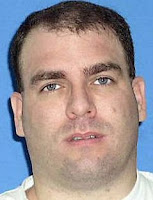
 |
| Larry Swearingen |
As soon as Rick Perry threw his hat into the 2012 electoral ring, anti–death penalty critics brought up his staggering execution record as governor of Texas: 234 prisoners have been put to death under Perry’s watch, a number of whom had serious innocence claims.
Most famous among them is Cameron Todd Willingham, who was executed in 2004 and whose case opened up an investigation that Perry has taken aggressive—and largely successful—measures to squash. But a lesser-known case could also haunt the governor if it reaches his desk: that of Larry Swearingen, convicted and sent to death row for the kidnapping, rape and murder of a 19-year-old college freshman named Melissa Trotter in 1998.
Like Willingham, Swearingen was convicted largely on circumstantial evidence and a history of run-ins with the law. But Willingham was convicted based on the inexact science of arson investigations, whose flawed assumptions have been slow to evolve. The scientific evidence in Swearingen’s case, medical experts say, is beyond dispute—and it proves his innocence.
Swearingen was scheduled to die on August 18. But his execution was stayed in late July by the state’s highest criminal court, the notoriously pro-prosecution Court of Criminal Appeals, in order to have the trial court consider new evidence: Histological samples of Trotter’s cardiac, lung and vascular tissue that a growing number of doctors, including well-respected Texas pathologists, say show conclusively that Swearingen could not have killed Trotter.
But is that enough? The Swearingen case has raised questions about the intersection of science and the law: how courts and cops view science, and how decisions are made about what kind of scientific proof is “good enough” to override the type of circumstantial evidence that lends itself to the finality of conviction that Texas courts crave—especially in death penalty cases.
On December 8, 1998, during finals week, Trotter drove to campus for a biology class review at Montgomery College, just North of Houston. That night she failed to return to her parents’ house in Willis, a small town just eight miles away. This was especially odd since her brother, stationed at an overseas Army post, had come home for a break and the family—the two kids and their parents, Sandra and Charles—had dinner plans.
For weeks there was no sign of Trotter. Police repeatedly searched the dank pine woods of the Sam Houston National Forest, which surrounds the northern shores of the man-made Lake Conroe, located West of Willis. On January 2, a group of locals was out searching for firearms that had gotten lost while hunting a few days before—in the same area of woods that police had previously searched. They made a gruesome discovery: the body of a young woman. “At first I thought it was a mannequin,” Raglind told then–Montgomery County, Texas, prosecutor Michael Tiffin. “I mean…you’re not expecting to see a body,” he testified. “I walked up to it…I touched it…. It felt like flesh to me.”
It was the body of Melissa Trotter.
Even though it took several weeks to find her body, police had been fairly certain that Trotter was dead early on. What’s more, they thought they knew who was responsible: Larry Swearingen, a 27-year-old married electrician with a modest history of trouble with the law. Swearingen had been seen talking with Trotter at the college the day she disappeared. The police maintain that Swearingen was the last person to see her alive.
3 days after Trotter disappeared, police arrested Swearingen on outstanding warrants. After her body was found, Swearingen was charged with capital murder—according to the state, Swearingen kidnapped, raped and then murdered Trotter by strangling her with a single leg of pantyhose, cut from a pair, before dumping her body in the forest. Prosecutors sought, and got, the death penalty.
Yet Swearingen maintains his innocence, and his date with death has been postponed 3 times by the courts. At issue is the science surrounding Trotter’s death, specifically, the science of decomposition. Doctors say the histological evidence shows conclusively that Trotter had not been dead for twenty-five days when her body was found. Samples of Trotter’s tissue—taken almost three weeks after Swearingen was locked up—are consistent with that of a person dead less than a week. Despite doctors’ insistence that Trotter could not have been dead and her body left outside for nearly a month, Texas authorities remain unconvinced that this proves Swearingen’s innocence. Trotter’s parents, too, remain certain that Swearingen killed their daughter. “How long can they examine this evidence?” Sandra Trotter asked in the Houston Chronicle this summer. “From the victims’ rights view, when does this end?”
There is no doubt that Swearingen was among the last to see Trotter alive. The two were acquaintances—both lived in Willis, and Swearingen’s sister had gone to school with Trotter—and Swearingen saw Trotter the day she disappeared. He had gone to the college that day to talk with a campus cop, for whom he had promised to do some work, according to trial testimony, and he ran into Trotter while she was working at a computer in the library. According to Swearingen, it was the last time he saw her.
Although there was no direct evidence linking Swearingen to the murder, there was plenty of circumstantial evidence upon which the prosecutors rested their case. Most damning was a single leg of pantyhose discovered several days after Trotter’s body. Found by his landlord inside the trailer home that Swearingen rented with his wife, Terry, the pantyhose leg was a visible match to the leg found knotted around Trotter’s neck, a Texas Department of Safety analyst said at trial.
Swearingen did not do himself any favors at trial. Over the vociferous objections of his defense attorneys, he took the stand in his own defense, delivering a rambling testimonial. He said that on the day she disappeared, Trotter told him that she’d had a disagreement with another man—and he said that he’d actually seen her with this mystery man, but had failed to mention this to police. The college had no video surveillance, so determining whom Trotter was last seen with at the college is impossible.
Several witnesses who said they saw her talking to a man in the library could not positively identify Swearingen as that person. Instead, they described Trotter’s companion as blond—a description that Swearingen’s appeal attorney, Houston’s James Rytting says does not match his client, who has “dark hair and dark eyebrows; he’s a swarthy man.” In short, the witness testimony putting Swearingen and Trotter together at the college on the day she disappeared was tenuous and confusing. Still, to prosecutors it was far more cohesive than Swearingen’s muddled defense. And Swearingen’s defense team didn’t do much to challenge the state’s basic theory of the case, focusing their efforts instead on disputing the charges of rape and kidnapping, since without an aggravating offense, the murder would not be a capital crime. It was an effort to save their client from lethal injection.
It didn’t work. “When you stop and look at all of the evidence here…you’re going to see one thing,” prosecutor Tiffin said during closing arguments. “All roads lead to Larry Swearingen.”
Had Swearingen’s lawyers focused on the medical evidence more closely, they could have built another road—the one that Rytting has been developing since taking the case on appeal: medical proof does not match the state’s theory of the case, and points strongly toward another killer, he says. Evidence left unexplained includes male DNA found in Trotter’s fingernails, which does not match Swearingen. But more importantly, there is the tissue evidence that more than a half-dozen respected forensic scientists from Texas and beyond say is completely inconsistent with the state’s theory of Trotter’s death.
Dr. Lloyd White, a deputy medical examiner in Ft. Worth, first called into question the biological evidence in Swearingen’s case back in 2007. The autopsy, which had been performed by Dr. Joye Carter, then the chief ME in Houston, described organs that were easily dissected and weighed. Had the body been outside for nearly a month, White told Rytting, that would not be possible. North Carolina doctor G.M. Larkin agreed: “All pathological diagnoses are based on the fact that changes in death are predictable, cumulative and irreversible,” he wrote in his findings. In this case, the “undisputed forensic evidence,” was that Trotter did not die until late December.
In late 2007, Carter recanted her trial testimony, which claimed that Trotter had likely been dead for twenty-five days, saying that the internal organs belied that conclusion. Why she didn’t grasp the import of those findings in 2000 is unclear; Carter did not return calls requesting comment.
Then, in 2009, Rytting got access to the histological evidence Carter preserved in 1999, but which had never been made available to the defense for some reason. Analysis of those tissues, done with a high-powered microscope used in marine biology studies, were performed last year and again in June. The results have caused doctors to further shorten their timeline for Trotter’s death: Now, they say, it is likely that Trotter was dead only 2 or 3 days before being left in the forest—weeks after Swearingen was behind bars. “The way biological tissue reacts [during decomposition],” says Dr. Stephen Pustilnik, the medical examiner for Galveston County, Texas, who has also reviewed the evidence, “there’s no doubt about it. Period. End of story.” With the tissues under the microscope “looking as good as they do,” he concluded, “it’s incontrovertible.”
Under the microscope, Dr. White and a colleague, Dr. Gary Sisler, were able to see clearly the intact cellular structures of Trotter’s lungs, heart and vasculature, basic structures that break down quickly after death—and which certainly would not remain intact for a month in a body exposed to the elements. “Any reasonable person can easily comprehend what would happen to a piece of meat if it were periodically removed from an ordinary kitchen refrigerator, usually kept at 40 degrees, and left outside on the ground in 70 degree weather for three weeks,” the doctors wrote in their June 20 report.
Still unclear is whether the Texas courts or its prosecutors will understand, and accept, this basic biology lesson. William Delmore, the affable assistant DA in Montgomery County, a veteran Texas prosecutor, is unconvinced. “The science is mystifying to me,” he recently said. In fact, he’s concerned that maybe “more is being made of it than we should actually give credit for.”
That’s exactly the reaction thus far from the Texas courts. Although the Court of Criminal Appeals sent the case back to have the recent tissue evidence considered—judges have yet to be swayed that the decidedly less “hard” science—like the visual match of the pantyhose legs—should take a backseat to the biological analysis.
“The hallmark of a scientifically sound hypothesis is that it is consistent with, and accounts for, the totality of the known facts,” Texas appeal Judge Cathy Cochran wrote in a 2009 opinion in the case. “If Melissa did not die until December 29th, where was she and what was she doing from her disappearance…until 21 days later?”
That, of course, remains the question—and it is where science and the law have clashed in this case. University of Texas School of Law professor Jordan Steiker, who is a co-director of the school’s capital punishment clinic, says that it is a conceit of the law that science must overcome intuitive biases. “There’s this deep intuition that when someone disappears and they’re not heard from, that they’re not out there,” he explains. “That’s the hard thing that the science is running up against.”
Courts in Texas have proven on numerous occasions that they do not consider scientific evidence as representing a gold standard for reliability. This has happened, infamously, in DNA cases; DNA science is considered so reliable that courts rely on it in the face of whatever circumstantial or eyewitness evidence would contradict it. In Texas, that has led so far to the exonerations of forty-four men, most convicted of sexual assaults—and more than one who had been sentenced to death.
The doctors in the Swearingen case are adamant that the science in question—histology and gross anatomy, the basic building blocks for modern medicine—cannot be dismissed. If the court rejects this evidence, they argue, they are turning their backs on the basic work done by the state’s forensic pathologists, tasked with determining both cause and manner of death, in thousands of cases each year.
Basic science, according to Dr. White, proves that Swearingen could not have killed Trotter. “It isn’t possible that…Trotter was killed and her body left at that location by…Swearingen,” he wrote in a June 20 report. This conclusion is “affirmed beyond all reasonable doubt.”
Source: The Nation, August 30, 2011
Related articles:
Aug 18, 2011
Larry Swearingen, 37, faced lethal injection Tuesday evening for the death of Melissa Trotter, whose body was found Jan. 2, 1999, in the Sam Houston National Forest south of Huntsville. The discovery came 25 days after . ...
Jul 29, 2011
Swearingen was convicted of the 1998 kidnap-rape-murder of 19-year-old Melissa Trotter in Montgomery County. Prosecutors have said – and the CCA has previously agreed – that a "mountain" of evidence links Swearingen ...
Jan 27, 2009
Larry Swearingen, 37, faced lethal injection Tuesday evening for the death of Melissa Trotter, whose body was found Jan. 2, 1999, in the Sam Houston National Forest south of Huntsville. The discovery came 25 days after ...
Aug 07, 2011
But after the Texas Court of Criminal Appeals last week issued a third stay of execution, Mr. Swearingen, a former electrician and father of five, and his lawyers hope they will get to present their evidence in court and exonerate ...
Comments
Post a Comment
Pro-DP comments will not be published.