Singapore should follow Malaysia in abolishing death penalty

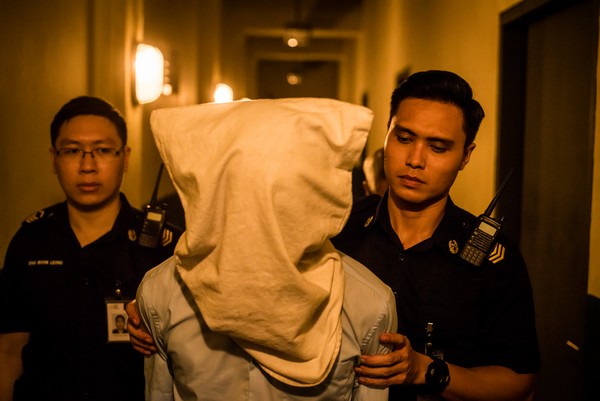
Screenshot from "Apprentice" by Boo Junfeng
Malaysians Against Death Penalty and Torture (Madpet) is disappointed that Singapore, which is just one of four countries still conducting execution for drug offences in 2017, went ahead and hanged 31-year-old Malaysian Prabu Pathmanathan on 26 October 2018.

Prabu was sentenced to death for committing several acts preparatory to and for the purposes of trafficking 228g of diamorphine or heroin into the island state on 31 December 2014 (Malaysiakini, 26 October 2018).

According to a report in The Online Citizen, Prabu was just one of a possible four individuals who were executed that week. TOC reported: “Ali Bin Mohamad Bahashwan was executed alongside his co-accused Selamat Bin Paki on Wednesday afternoon (24 October 2018)… Irwan Ali, a Singaporean, is the other inmate who is set to be executed this Friday…” (TOC, 26 October 2018).

The Singapore Prison Service 2017 annual report showed eight people were executed in 2017, up from four in 2016. Actual statistics of executions carried out in 2018 cannot be confirmed, as Singapore continues to be ‘secretive’ and not transparent with such data. It is believed that there may have already been about eight executions to date in 2018.

Many times in Singapore, one becomes aware of upcoming executions only when the immediate family is informed days before and takes the trouble to inform anti-death penalty advocates and groups.


The death sentence is provided for drug-related crimes in about 15 countries, but according to Amnesty International only four countries recorded drug offence executions in 2017 – Singapore, Iran, Saudi Arabia, and China (South China Morning Post/SCMP, 26 October 2018).

In reality, the majority of those executed for drug trafficking will not be “kingpins” but are just low-level offenders.

Many may have been driven to crime through poverty, which highlights a failure of governments in ensuring the wellbeing and livelihood of its people. Singapore, Malaysia and other states must really look into the link of poverty to crime, and maybe the solution to crime reduction may be a caring government policy that will ensure that no one will ever need to resort to crime out of desperation for the wellbeing of themselves and their families.

Singapore also needs to strive to become a more caring and civilised nation and do away with the archaic death penalty just like neighbouring Malaysia, which has already made the decision to totally abolish the death penalty.

In Malaysia, the necessary bills will be tabled at this current parliamentary session, which will give effect to the cabinet decision to abolish the death penalty.

Madpet calls on Singapore to follow neighbouring Malaysia and abolish the death penalty, as we strive forward for a more caring and civilised Asean where there is no more death penalty and torture.

Madpet also calls on Malaysia to immediately identify Malaysians on death row at risk of being executed in Singapore prisons and proactively act now to save them from being executed by Singapore. This is a priority, as knowledge about impending executions only comes to light at the eleventh hour and that too in only certain cases.


Madpet further calls on Singapore to impose a moratorium on executions and abolish the death penalty.

Source: aliran.com, Charles Hector, November 29, 2018. Charles Hector issued this statement on behalf of Malaysians Against Death Penalty and Torture (Madpet).


⚑ | Report an error, an omission, a typo; suggest a story or a new angle to an existing story; submit a piece, a comment; recommend a resource; contact the webmaster, contact us: deathpenaltynews@gmail.com.


Opposed to Capital Punishment? Help us keep this blog up and running! DONATE!


"One is absolutely sickened, not by the crimes that the wicked have committed,
but by the punishments that the good have inflicted." -- Oscar Wilde

Most viewed (Last 7 days)

Singapore executes three drug mules over two days

Singapore hanged three people for drug offences last week, bringing the total number of executions to 17 this year - the highest since 2003. These come a week before a constitutional challenge against the death penalty for drug offences is due to be heard. Singapore has some of the world's harshest anti-drug laws, which it says are a necessary deterrent to drug crime, a major issue elsewhere in South East Asia. Anyone convicted of trafficking - which includes selling, giving, transporting or administering - more than 15g of diamorphine, 30g of cocaine, 250g of methamphetamine and 500g of cannabis in Singapore will be handed the death sentence.

Florida | After nearly 50 years on death row, Tommy Zeigler seeks final chance at freedom

The Winter Garden Police chief was at a party on Christmas Eve 1975 when he received a phone call from his friend Tommy Zeigler, the owner of a furniture store on Dillard Street. “I’ve been shot, please hurry,” Zeigler told the chief as he struggled for breath. When police arrived at the store, Zeigler, 30, managed to unlock the door and then collapsed “with a gaping bullet hole through his lower abdomen,” court records show. In the store, detectives found a gruesome, bloody crime scene and several guns. Four other people — Zeigler’s wife, his in-laws and a laborer — lay dead.

Louisiana death row inmate freed after nearly 30 years as overturned conviction upends case

A Louisiana man who spent nearly 30 years on death row walked out of prison Wednesday after a judge overturned his conviction and granted him bail. Jimmie Duncan, now in his 60s, was sentenced to death in 1998 for the alleged rape and drowning of his girlfriend’s 23-month-old daughter, Haley Oliveaux — a case long clouded by disputed forensic testimony. His release comes months after a state judge ruled that the evidence prosecutors used to secure the conviction was unreliable and rooted in discredited bite-mark analysis.

Oklahoma board recommends clemency for inmate set to be executed next week

A voting board in Oklahoma decided Wednesday to recommend clemency for Tremane Wood, a death row inmate who is scheduled to receive a lethal injection next week at the state penitentiary in McAlester.  Wood, 46, faces execution for his conviction in the 2001 murder of Ronnie Wipf, a migrant farmworker, at an Oklahoma City hotel on New Year's Eve, court records show. The recommendation was decided in a 3-2 vote by the Oklahoma Pardon and Parole Board, consisting of five members appointed by either the governor or the state's top judicial official, according to CBS News affiliate KWTV. Oklahoma Gov. Kevin Sitt will consider the recommendation as he weighs whether to grant or deny Wood's clemency request, which would mean sparing him from execution and reducing his sentence to life in prison without the possibility of parole.

Vietnam | Woman sentenced to death for poisoning 4 family members with cyanide

A woman in Dong Nai Province in southern Vietnam was sentenced to death on Thursday for killing family members including two young children in a series of cyanide poisonings that shocked her community. The Dong Nai People's Court found 39-year-old Nguyen Thi Hong Bich guilty of murder and of illegally possessing and using toxic chemicals. Judges described her actions as "cold-blooded, inhumane and calculated," saying Bich exploited the trust of her victims and "destroyed every ethical bond within her family."

Afghanistan | Two Sons Of Executed Man Also Face Death Penalty, Says Taliban

The Taliban governor’s spokesperson in Khost said on Tuesday that two sons of a man executed earlier that day have also been sentenced to death. Their executions, he said, have been postponed because the heir of the victims is not currently in Afghanistan. Mostaghfer Gurbaz, spokesperson for the Taliban governor in Khost, also released details of the charges against the man executed on Tuesday, identified as Mangal. He said Mangal was accused of killing members of a family.

Afghanistan's Taliban rulers carry out public execution in sports stadium

The man had been convicted of killing 13 members of a family, including children, and was executed by one of their relatives, according to police. Afghanistan's Taliban authorities carried out the public execution of a man on Tuesday convicted of killing 13 members of a family, including several children, earlier this year. Tens of thousands of people attended the execution at a sports stadium in the eastern city of Khost, which the Supreme Court said was the eleventh since the Taliban seized power in 2021 in the wake of the chaotic withdrawal of US and NATO forces.

Utah | Ralph Menzies dies on death row less than 3 months after his execution was called off

Judge was set to consider arguments in December about Menzies’ mental fitness  Ralph Menzies, who spent more than 3 decades on Utah’s death row for the 1986 murder of Maurine Hunsaker, has died.  Menzies, 67, died of “presumed natural causes at a local hospital” Wednesday afternoon, according to the Utah Department of Corrections.  Matt Hunsaker, Maurine Hunsaker’s son, said Menzies’ death “was a complete surprise.”  “First off, I’d say that I’m numb. And second off, I would say, grateful,” Hunsaker told Utah News Dispatch. “I’m grateful that my family does not have to endure this for the holidays.” 

Iran carries out public hanging of "double-rapist"

Iran on Tuesday publicly executed a man after convicting him of raping two women in the northern province of Semnan. The execution was carried out in the town of Bastam after the Supreme Court upheld the verdict, the judiciary's official outlet Mizan Online reported. Mizan cited the head of the provincial judiciary, Mohammad Akbari, as saying the ruling had been 'confirmed and enforced after precise review by the Supreme Court'. The provincial authority said the man had 'deceived two women and committed rape by force and coercion', adding that he used 'intimidation and threats' to instil fear of reputational harm in the victims.

Burkina Faso to bring back death penalty

Burkina Faso's military rulers will bring back the death penalty, which was abolished in 2018, the country's Council of Ministers announced on Thursday. "This draft penal code reinstates the death penalty for a number of offences, including high treason, acts of terrorism, acts of espionage, among others," stated the information service of the Burkinabe government. Burkina Faso last carried out an execution in 1988.