 |
| The United States Supreme Court |
WASHINGTON — Supreme Court justices engaged in an impassioned debate Wednesday about capital punishment, trading unusually combative words in a case involving a drug used in several botched executions.
The justices are considering the plea of death row inmates in Oklahoma to outlaw the sedative midazolam. The inmates say it is ineffective in preventing searing pain from other drugs used in lethal injections.
But Wednesday’s session, lasting just over an hour, featured broader complaints from conservative justices that death penalty opponents are waging what Justice Samuel Alito called a “guerrilla war” against executions by working to limit the supply of more effective drugs.
On the other side, among the court’s liberals, Justice Elena Kagan contended that the way states carry out most executions amounts to having prisoners “burned alive from the inside.”
The debate came on the court’s last argument day until fall, and a year to the day after a problematic execution in Oklahoma gave rise to a lawsuit from death row inmates over the use of midazolam.
The outcome of the case could turn on a rather narrow question involving the discretion of the federal trial judge who initially heard the lawsuit. He ruled against the inmates, and a unanimous three-judge panel of the federal appeals court in Denver affirmed that ruling.
But justices on both sides gave voice to larger concerns.
“There are other ways to kill people, regrettably, that are painless,” Justice Sonia Sotomayor said.
Justice Stephen Breyer said it’s not the inmates’ fault if the state can’t find drugs that work painlessly.
He said, “Perhaps there is that larger question, that ... if there is no method of executing a person that does not cause unacceptable pain, that, in addition to other things, might show that the death penalty is not consistent with the Eighth Amendment,” which forbids cruel and unusual punishment.
But the conservative justices said that the court has already upheld the use of capital punishment and that there must be ways of carrying out executions.
Source: The Dallas Morning News, April 29, 2015
The Beginning of the End
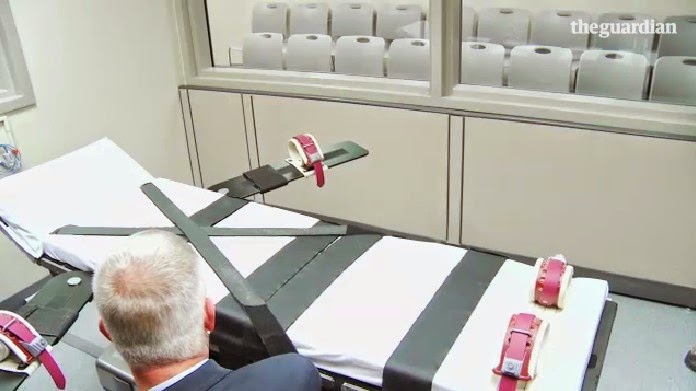 |
| Oklahoma death chamber |
Following a string of horrific botched executions, the US Supreme Court is considering a case that could lead to a ban on lethal injections. The alternatives are so cruel that they might bring the country closer to abolishing capital punishment.
On the morning of July 23, 2014, lawyer Dale Baich went to visit his client Joseph Wood for 1 last time in his cell at a prison in Florence, Arizona. Wood was set to die one hour later. In the neighboring room, officials were already preparing for his execution.
Baich had come with good news. The Supreme Court of Arizona had just delayed Wood's execution. The judge needed more time to evaluate the validity of his lawsuit. Baich had filed a suit about the chemical which was to be administered to Wood: midazolam, a sedative that had previously only been used in a few executions. Following decisions by a number of pharmaceutical companies around the world to prohibit the use of their products in executions, midazolam had become an emergency solution for states that allow the lethal injection.
'Cruel and Unusual Punishment'
Baich argued that injecting midazolam, which is used by doctors as a sedative before anesthesia, was akin to human experimentation. He argued there are doubts that the substance can induce a quick, deep and lasting state of unconsciousness. Wood, he claimed, would face a painful struggle to the death -- a violation of the Eighth Amendment of the US Constitution, which bans "cruel and unusual punishment."
Sitting in his office in Phoenix, Baich recollects about Wood's euphoric reaction to the delay at the time. "He was emotionally overwhelmed," says Baich, who has been defending death row inmates for 25 years. His role often goes well beyond that of being their attorney given that he's one of the people closest to the convicts prior to their execution.
2 hours later, on July 23, Baich again entered Woods' cell, this time to say goodbye. The court had made its decision, and this time declared his objections to be baseless. At 1:54 p.m., the midazolam that Baich had filed suit against flowed into Woods' arm. At 1:57, a doctor declared Wood unconscious. 8 minutes later, Wood began to visibly gasp for air. He moved his head and looked at Baich behind the glass window. His chest curved as he gasped. He continued -- gasping for air and then expelling it -- a total of 640 times.
Botched Executions
After an hour, Baich tried to leave the witness room so he could convince judges and other legal authorities to call off the execution. One hour after that, Wood had lost his battle. If things had gone according to procedure, the execution would only have lasted 10 minutes. Wood's execution, however, was the longest in the history of the lethal injection.
Three months earlier, Clayton Lockett's execution in Oklahoma had been the most gruesome lethal injection ever. It had lasted 43 minutes, during which he sat up, moved his feet and spoke. "Something is wrong," he said. "The drugs aren't working."
A short while earlier in Oklahoma, Dennis McGuire had also gasped and heaved for a long time before he died. All 3 executions had one thing in common: midazolam.
"The experiment has failed," Dale Baich said in the witness room after Wood's execution. Nine months later, he is preparing for the trial of his life. The Supreme Court in Washington is finally taking on his suit opposing midazolam. After a hearing today, the country's highest court is expected to rule on whether or not the controversial compound can be used in future executions.
There's more at stake in this trial than simply the fates of the three death row inmates listed in Baich's suit. It's about ending lethal injection, which is used in all 32 US states that still allow the death penalty. At the moment, almost all states are dependent on the easily available midazolam.
For two decades, US executioners had used a reliable agent called sodium thiopental, but then its manufacturers stopped producing it. Since the European Union introduced export restrictions on drugs potentially used in executions, an alternative compound, Pentobarbital, hasn't been available either.
End of an Era?
Dale Baich drops a thick file on his desk -- expert opinions from professors, doctors, pharmacists. They all confirm that midazolam isn't suited for putting people into a deep and lasting state of unconsciousness. But without this anesthesia the other toxins administered during an execution would cause terrible amounts of pain. If the Supreme Court judges refrain from making an ideological decision, and instead follow scientists' findings, it could herald the end of the lethal injection.
Several states have already planned for that eventuality: Utah would return to using the firing squad, Tennessee to the electric chair, Arizona to the gas chamber. All of these methods would spur potentially successful lawsuits. What seemed medieval a few decades ago, courts may -- now more than ever -- classify as "cruel."
The alternate method getting the most attention is currently being debated in Oklahoma: execution via nitrogen, which would be administered by strapping down a death row inmate and forcing him or her to breathe in the gas through a mask. Some euthanasia activists praise this as the gentlest kind of death.
A victory at the Supreme Court won't mark the end of the death penalty, Baich says. But it could mark the beginning of the end.
Source: Spiegel Online, April 29, 2015 (WR)
Dangerous cocktails

Almost a year later, the Supreme Court heard challenges today from three death-row inmates who appear destined for a similar fate. The case, Glossip v Gross, turns on complex and hard-to-verify medical claims about the use of a new drug, midazolam, that apparently caused Lockett's pain and several other less-than-smooth executions in Ohio and Arizona.
Sodium thiopental, a barbiturate that reliably induces a coma-like state, was once the 1st of 3 drugs in the execution protocol pioneered by Oklahoma in 1977. But sources for this drug dried up in 2010 when European pharmaceutical companies opposed to the death penalty refused to export it for that purpose, and a domestic producer, Hospira, stopped making it in 2011. Oklahoma turned to pentobarbital, another barbiturate, but this drug also became hard to locate. The central question for the justices is whether midazolam is up to the task of knocking out a criminal before the 2 other drugs - a paralytic to quiet the body and potassium chloride to stop the heart - are injected. These drugs, in people who are not fully unconscious, produce searing pain. When the justices approved the earlier trio of drugs 7 years ago in Baze v Rees, they did so on the grounds that the cocktail did not carry a "substantial risk of serious harm." If midazolam does pose such a risk, it would constitute a "cruel and unusual punishment" that is prohibited by the 8th amendment.
Though the case challenges only the constitutionality of a particular drug and not capital punishment per se, the politics of the death penalty pervaded much of the oral argument. "Let's be honest about what's going on here," said Justice Samuel Alito in a tone that was even testier than usual (which is saying something). "Oklahoma and other states could carry out executions painlessly," he said, pointing to jurisdictions where assisted-suicide laws allow for an easeful death. Yet the state has been boxed into a corner by a "guerrilla war against the death penalty." It would be inappropriate, he held, for the justices to "countenance" that war, "which consists of efforts to make it impossible for the states to obtain drugs that could be used to carry out capital punishment with little, if any pain."
Justice Antonin Scalia extended this line of reasoning. More effective sedatives "have been rendered unavailable by the abolitionist movement putting pressure on the companies that manufacture them". Isn't that "relevant," he said, "to the decision that you're putting before us?"
Robin Konrad, the attorney arguing against using midazolam, seemed caught off guard. Though she gave the correct answer - "I don't think that it's relevant" -she did not put nearly enough force behind her response. It doesn't matter at all, from the point of view of the 8th amendment, why a particular drug has come to be adopted by a state for its execution regimen. If that drug fails to do its job, if it gives prisoners the sensation of being burned alive, it is unconstitutional. Ms Konrad's 3 clients should not have to be tortured to death because drug manufacturers - whether under pressure from death-penalty abolitionists or of their own accord - no longer supply drugs that kill criminals painlessly.
The lawyer for Oklahoma, Patrick Wyrick, was unflappable in the face of an unusually aggressive series of questions from Justice Sonia Sotomayor. Fielding her long critique of specific points in his brief, Mr Wyrick responded with a greater command of the medical details, correcting her misinterpretations ("respectfully, you have that backwards") and picking apart the studies on which the petitioners' expert witness relied. But he had some trouble with this question from Justice Elena Kagan:
"Do you think that if we conclude that there is just a lot of uncertainty about this drug, in other words, you know, you might be right, or Ms. Konrad might be right, and it's really just impossible to tell. Given that nobody does studies on this drug, it would be unethical to do studies on this drug, we simply can't know the answer to these questions. If that's the state of the world, do you think it's a violation of the Eighth Amendment to use it?"
Here Mr Wyrick just reverted to the legal standard, which puts the burden on the petitioner to show a clear error in the lower court's factual judgment that midazolam does in fact work as intended. It is unclear if a majority of the justices will agree that Ms Konrad showed such an error. 4 justices seem inclined to uphold the drug, and 4 seem aghast that Oklahoma is still intending to use it. Justice Anthony Kennedy, the oft-swing vote, was largely mum today, revealing little about his view.
Source: The Economist, April 30, 2015
Report an error, an omission: deathpenaltynews@gmail.com