Woman among 2 death-row inmates executed in Japan

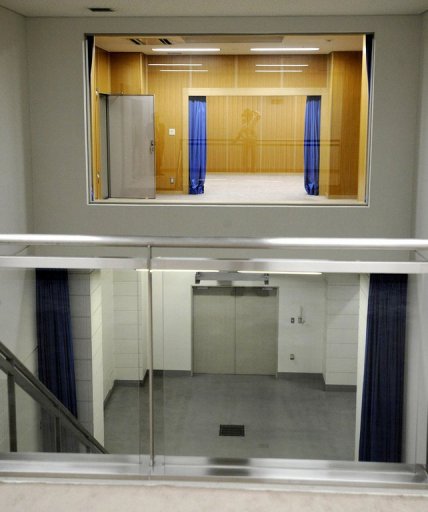
Execution chamber
at Tokyo Detention Center
A faith healer who beat six followers to death was hanged on Sept. 27, making her only the fourth woman to be executed in Japan since 1950, the Justice Ministry said.

Sachiko Eto, 65, was one of two convicted murderers put to death, taking to seven the number of executions carried out this year.

Eto's punishment was carried out at the Sendai Branch Detention House in northeastern Japan.

The slayings occurred during "exorcism" rituals in Sukagawa, Fukushima Prefecture, in 1994 and 1995. Two of the victims were male. Eto ordered the fatal beatings, which involved blows with heavy wooden sticks used for Taiko drumming, and took part in them with her followers.

Eto was originally sentenced to death by a district court, which was upheld on appeal to a high court. The Supreme Court finalized the sentence in 2008.

Yukinori Matsuda, 39, was hanged the same day at the Fukuoka Detention House in western Japan.

Matsuda was convicted in the stabbing murders of a couple during a burglary in Matsubase, Kumamoto Prefecture, now part of Uki, in 2003.

Matsuda made off with 80,000 yen ($1,030) in cash, a wrist watch and other items. He also was originally sentenced to death by a district court, which was upheld on appeal to a high court. His sentence was finalized after he retracted his appeal in 2009.

The executions, the second in two months, leave 131 inmates on death row.

The numbers have been increasing as death sentences continue to be handed down under the citizen judge system introduced three years ago.

It was the fourth round of hangings carried out under Democratic Party of Japan administrations since the party wrested control of government in September 2009, and the second set under Justice Minister Makoto Taki.

Execution chamber (right) and
trapdoor command room (left)
Taki, who is 74 years old and has asked to be relieved of his ministerial duties in a Cabinet reshuffle expected next month, denied that he rushed the executions while he was still in office.

Taki is the oldest minister in the Cabinet of Prime Minister Yoshihiko Noda.

"I am too old. I had better be left out (of the reshuffle)," Taki told a news conference on Sept. 25.

Taki said he began reviewing the death warrants for Eto and Matsuda even before two other executions were carried out on Aug. 3.

"I decided on the (latest) executions before I made the remark (about being too old)," he said.

Although he is a strong supporter of the death penalty, Taki has called for national debate on capital punishment, which opinion polls show has strong support in Japanese society.

"My basic idea is that those who were sentenced to death should be executed," he said. "(But) it is an issue that needs to be discussed constantly.

"There is a limit to what discussions within the (justice) ministry can do," Taki added. "What matters is how the general public perceives this question."

When the Liberal Democratic Party was in power, executions began to be regularly carried out under Justice Minister Masaharu Gotoda. He resumed executions in 1993 following a 40-month hiatus.

The pace of executions accelerated around the time Jinen Nagase became justice minister in 2006.

Under Kunio Hatoyama, 13 death row inmates were hanged during his 11 months in office.

Hatoyama caused much controversy by saying he wished a system was in place to "automatically" execute death inmates without the justice minister having to review the cases.

Eisuke Mori, the last justice minister under an LDP administration, ordered nine executions during his 11 months in office.

The DPJ, acknowledging a global trend to abolish capital punishment, floated the idea of introducing life imprisonment without the possibility of parole after it took the reins of government in 2009.

Keiko Chiba, the first justice minister under the DPJ-led government, was opposed to the death penalty. Even so, she ordered two hangings in July 2010 and then called for "national debate" on the issue.

A 20-month lull in executions followed as justice ministers came and went. But no national debate was held on the merits of capital punishment.

Executions resumed in March, when Justice Minister Toshio Ogawa ordered three inmates hanged.

He said executions were part of his official duties.

Seven convicted murderers have been executed this year, almost at the pace of LDP-led administrations.

Source: The Asahi Shimbun, Sept. 27, 2012

Most viewed (Last 7 days)

Arizona | Man who murdered pastor crucifixion style requests plea deal after parents killed in plane crash

Adam Sheafe, the California man who admitted to killing a New River, Arizona, pastor in a crucifixion-style attack, has asked prosecutors to offer him a plea deal that would result in a natural life sentence rather than the death penalty he had previously sought. Advisory council attorneys representing Sheafe sent a formal plea offer to prosecutors this week, about two weeks after his father and stepmother died in a plane crash at Marana Airport on April 8, according to 12 News. Sheafe, 51, is charged with first-degree murder in the death of William Schonemann, 76, pastor of New River Bible Church, who was found dead inside his home last April.

US Department of Justice announces decision to resume federal executions

The Department of Justice (DOJ) announced on Friday that it will resume the federal use of capital punishment and that it is seeking death sentences against 44 defendants. DOJ also said that it will use firing squads, electrocution, or nitrogen asphyxiation if the drug used in lethal injection is unavailable. The announcement follows the Restoring and Strengthening the Federal Death Penalty report, published on April 24. The report is especially critical of the moratorium on federal executions, ordered by Attorney General Merrick Garland in July 2021, to remain until the death penalty could be conducted “fairly and humanely.” Garland was concerned about the federal lethal injection protocol, which uses only one drug, pentobarbital, and the possibility that it causes “unnecessary pain and suffering.” In response to Garland’s moratorium and concerns, President Biden commuted the sentences of 37 prisoners on federal death row, leaving only three prisoners.

China | Man sentenced to death for murder executed in Yunnan

Tian Yongming, who was initially sentenced for a series of violent crimes and then had his sentence changed to death early this year, has been executed in Yunnan province following approval from China's top court. The execution was carried out by the Intermediate People's Court in Yuxi, Yunnan, on Tuesday, with local prosecutors supervising the process. Before the execution, Tian was allowed to meet with his family members. The case dates back to September 1996, when Tian was sentenced to nine years in prison for the rape and attempted murder of his sister-in-law. After his release on July 15, 2002, he plotted revenge against the woman. On the night of Nov 13, 2002, he broke into her home armed with a knife.

20 Minutes to Death: Witness to the Last Execution in France

The following document is a firsthand account of the final moments of Hamida Djandoubi, a convicted murderer executed by guillotine at Marseille’s Baumettes Prison on September 10, 1977. The record—dated September 9—was written by Monique Mabelly, a judge appointed by the state to witness the proceedings. Djandoubi’s execution would ultimately be the last carried out in France before capital punishment was abolished in 1981. At the time, President Valéry Giscard d'Estaing—who had publicly voiced his "deep aversion to the death penalty" prior to his election—rejected Djandoubi’s appeal for clemency. Choosing to let "justice take its course," the President allowed the execution to proceed, just as he had in two previous cases during his term:   Christian Ranucci , executed on July 28, 1976 and Jérôme Carrein , executed on June 23, 1977. Hamida Djandoubi , a Tunisian national, was sentenced to death for killing his former lover, Elisabeth Bousquet. He was execu...

Florida executes Chadwick Scott Willacy

STARKE, Fla. -- A Florida man who set his neighbor on fire after she returned from work to find him burglarizing her home was executed Tuesday evening. Chadwick Scott Willacy, 58, received a three-drug injection and was pronounced dead at 6:15 p.m. at Florida State Prison near Starke for the 1990 killing of Marlys Sather. It was Florida's fifth execution this year. The curtain to the execution chamber went up promptly at the scheduled 6 p.m. time, and the lethal injection got underway two minutes later, after Willacy made a brief statement.

Iran to execute first woman linked to mass protests after ‘forced confessions’

Bita Hemmati and three others have been sentenced to death for 'collusion' and 'propaganda.' Advocates claim the charges are baseless, citing a secretive process and state-televised interrogations. Iranian authorities are preparing to execute Bita Hemmati, the first woman sentenced to death in connection with the mass protests in Tehran in late December and January, according to the US-based non-profit the Human Rights Activists News Agency. Judge Iman Afshari, of Branch 26 of the Tehran Revolutionary Court, sentenced Hemmati, her husband, Mohammadreza Majidi Asl, and Behrouz Zamaninezhad, and Kourosh Zamaninezhad to death on the charge of “operational action for the hostile government of the United States and hostile groups,” in addition to discretionary imprisonment period of five years on the charge of “assembly and collusion against national security.”  

Tennessee | Man set to be executed files motion claiming DNA evidence will exonerate him

MEMPHIS, Tenn. — Attorneys for death row inmate Tony Carruthers filed a motion in Shelby County Criminal Court seeking immediate DNA testing on evidence they claim will prove his innocence in a 1994 triple murder.  Carruthers is scheduled for execution on May 12. He was convicted and sentenced to death for the kidnapping and murders of 24-year-old Marcellos Anderson, 17-year-old Delois Anderson, and 21-year-old Frederick Scarborough. Prosecutors at trial alleged the victims were buried alive in a Memphis cemetery as part of a drug-related robbery.

Florida Schedules Two Executions for Late April

TALLAHASSEE, Fla. — Governor Ron DeSantis has directed the Florida Department of Corrections to move forward with two executions scheduled for late April 2026, marking a significant ramp-up in the state's use of capital punishment. The scheduled deaths of Chadwick Willacy and James Ernest Hitchcock follow a series of landmark judicial rulings that have kept both men on death row for decades.

Singapore executes man for trafficking 1kg of cannabis

SINGAPORE — Singaporean authorities executed Omar bin Yacob Bamadhaj at Changi Prison on Thursday, April 16, 2026, following his 2019 conviction for importing 1,009.1 grams of cannabis. Bamadhaj, 41, though some reports have cited his age as 46, was arrested on July 12, 2018, during a routine search at the Woodlands Checkpoint. Officers discovered the narcotics wrapped in plastic and hidden within his vehicle as he attempted to enter Singapore from Malaysia.  Under the Misuse of Drugs Act, the threshold for the mandatory death penalty involving cannabis is 500 grams, a limit this shipment exceeded by more than double.

Florida | Man avoids death penalty in Daytona Beach triple murder

Jerome Anderson shot and killed Antoine Melvin, 42, John Burch, 65, and Patrick Lassiter, 35, in 2023. A man pleaded no contest to a triple-murder in Daytona Beach and was sentenced April 20 to three consecutive life terms in prison as part of a plea deal in which he avoided a possible death sentence. Jerome Anderson, 41, was indicted on three counts of first-degree murder and possession of a firearm by a convicted felon in the 2023 triple-slaying. Anderson pleaded no contest to the three first-degree murder charges April 20 and, in exchange, Assistant State Attorney Andrew Urbanak agreed not to continue to pursue the death penalty.